Simulators are an indispensable asset for training and guiding the aircraft pilots, at very low cost and time. As technology evolves at a rapid pace and with advances in 3D technology and virtual reality, training in simulators has become as good as training in a real aircraft. The innovations in simulator technology have blurred the lines between real operating environment and virtual reality.
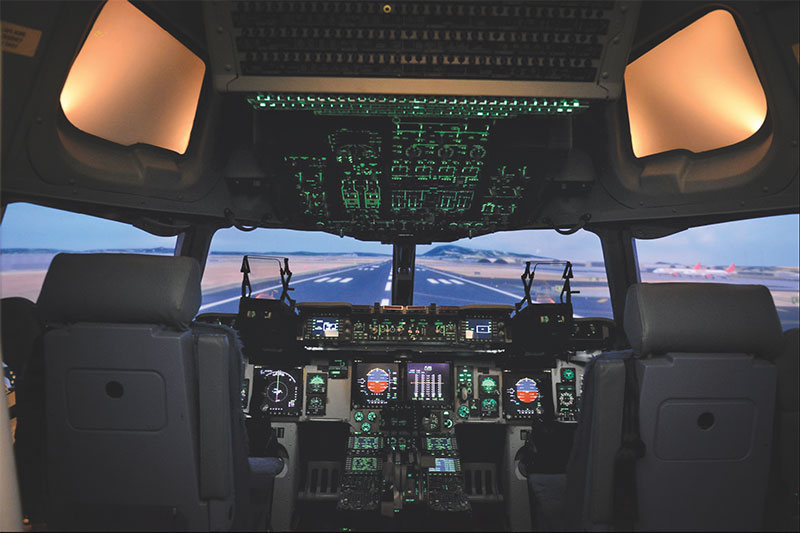
Boeing’s C-17 Globemaster simulator
The Full Mission Simulator (FMS) prepares the pilots for carrying out missions on the aircraft after extensive practice on the FMS. Many more countries are making it mandatory for the pilots to undergo minimum number of training hours on the simulator before flying the actual aircraft. Factors like limited airspace today and the high cost of pilot training makes simulators even more crucial and necessary for safety and cost reduction.
Flight simulators have come a long way since they were first introduced around 100 years ago. Today’s simulators can recreate reality so closely that their operation becomes indistinguishable from an actual sortie. With increasing complexity in the design of aircraft nowadays, with high-tech avionics, coupled with complete autonomous control of the aircraft, simulators assume critical importance in today’s aircraft operation. The fighter aircraft, on the other hand, call for a different level of training, with very limited time to respond to an exigency in such planes and the complex operations they carry out requires stringent cockpit training.
The Indian Air Force (IAF) is on a modernisation spree, with its increasing focus on aircraft modernisation and upgradation, along with the acquisition of advanced new aircraft, a comprehensive infrastructure is needed to train the pilots in a cost-effective environment. With more than 1,700 aircraft and the rising costs and increasing complexities of aircraft and other weapon platforms, resources are required to facilitate effective learning and keep track of the performance of the pilots and make it better.





 VIDEO
VIDEO