India has seemingly chosen indigenisation over modernisation after the Defence Research and Development Organisation (DRDO) successfully flight tested the indigenously developed third generation anti-tank guided missile (ATGM), Nag, twice on September 8 against two different targets in the ranges of Rajasthan. A similar test in the month of June earlier with the launcher system Nag Missile Carrier (NAMICA) had convinced DRDO of its efficacy. The Nag is meant to eventually replace foreign-made missiles to become the Indian military’s first and primary anti-tank weapon.
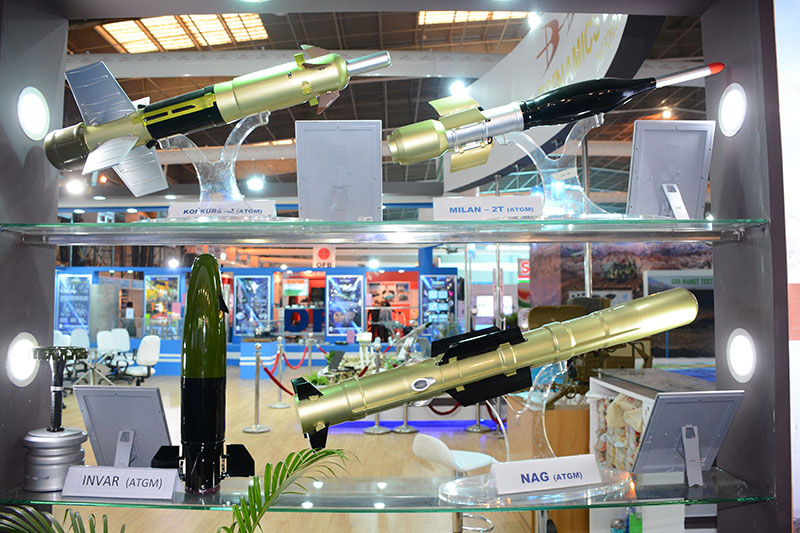
TANK KILLERS – ATGMs on display during Aero India 2015
This development was swiftly followed by reports that the ministry of defence (MoD) had cancelled the USD500 million deal for Spike ATGM with Rafael Advanced Defence Systems of Israel after price negotiations were already completed. In fact, Rafael had entered into a joint venture with the Kalyani group and set up a missile sub-systems manufacturing facility near Hyderabad which was inaugurated in August 2017.
The DRDO now has the arduous task of developing a Man-Portable Anti-Tank Guided Missile (MPATGM) for the army as soon as possible to make up for the cancelled project. Interestingly, the Israeli-made Spike ATGM was chosen over Javelin ATGM made by US-based Raytheon-Lockheed Martin by the MoD.
Nag is a fire-and-forget ATGM with ‘top attack’ capabilities and a range of about four kilometres while the NAMICA is an Indian license-produced variant of the Soviet-era BMP-II armoured infantry fighting vehicle. NAMICA can launch Nag missiles from a retractable armoured launcher that contains four launch tubes and a guidance package including a thermal imager for target acquisition. The missile’s targeting system is based on visual identification prior to its launch and is also equipped with highly advanced Imaging Infrared Radar (IRR) seeker and has integrated avionics technology in its arsenal. As per reports, few countries possess this integrated avionics technology. The ATGM will be of immense support to the mechanised infantry and airborne forces of the Indian Army when inducted but the fact remains that it is a third generation missile while Spike is a fourth generation one. Also, Nag, manufactured by state-owned Bharat Dynamics Limited (BDL), has so far only been tested while mounted on the NAMICA combat vehicle. The Indian Army has a total requirement of 40,000 anti-tank guided missiles in the next 20 years and needs missiles like Nag which can hit high-speed moving tanks without the support of an operator. Currently, the army is using 2nd generation ATGMs, Russian licensed Konkurs and French licensed Milan 2T, which do not have night-fighting capabilities.
The DRDO is also working on HeliNa ATGM, the helicopter launched version of Nag, with a maximum range of up to seven kilometers. Once operational, the HeliNa will be part of the armaments of the indigenously designed India’s fleet of light combat helicopters (LCH).








 VIDEO
VIDEO