On February 17, when the Supreme Court granted Permanent Commission (PC) to women officers in the army, the daughter of one of the woman officers (in the rank of Lt Col) who was among the petitioners fighting for Permanent Commission (name withheld on request) said to her mother, “It is not only your battle that has come to an end but I feel it is my battle also that has come to an end. I feel empowered.”
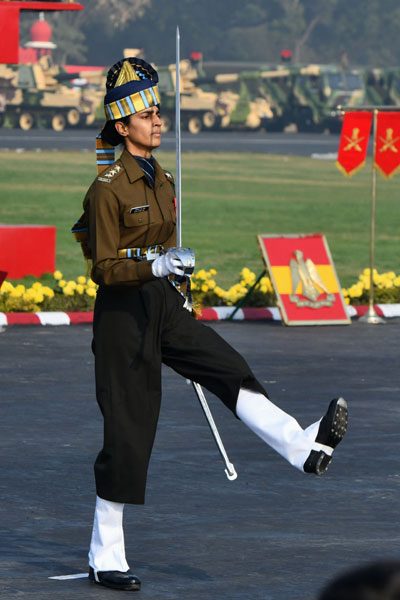 Tania Shergill
Eleven women officers had been fighting for more than a decade for the rights that their male colleagues already had. “We were fighting for our Right to Equality,” says the officer.
The government had offered two arguments before the apex court. One, that women were physiologically weaker; and two, that most soldiers came from rural background and would not be comfortable taking orders from a woman officer. The Supreme Court dismissed both saying that these violated the Right to Equality.
Women officers can now get promoted to higher ranks, get benefits and pensions like their male counterparts. Earlier, as short-service commission (SSC) officers, they could not become commanding officers or COs, the first aspirational level of anyone donning the uniform.
Timeline of Events
To go back in history, women officers were inducted into the army in December 1992 under the Women Special Entry Scheme (WSES) and were eligible to serve for a period for five years. In August 1996, an amendment was issued to the WSES, under which, the commission was extended by a period of five more years and women could be enrolled in the Regiment of Artillery, Corps of Engineers, Corps of Signals, Army Service Corps, Army Ordinance Crops, Corps of Electrical and Mechanical engineers, Army Education Crops (AEC), Intelligence Corps and Judge Advocate General (JAG) department.
In 2003, advocate Babita Puniya filed a Public Interest Litigation (PIL) before the Delhi High Court demanding PC to SSC officers in the army. In October 2005, the ministry of defence (MoD) made the 10 years appointment of women extendable up to 14 years.
Two circulars were issued in July 2006, conveying the sanction of the President of India regarding the grant of SSCs to both the technical and non-technical women officers and approving the government’s decision to extend the appointment by four more years.
Under the ambit of new scheme and rules, women officers were eligible to be promoted ‘to the rank of Captain on completion of two years, to the rank of Major on completion of six years and to the rank of Lt Col on completion of 13 years.’
However, in October 2006, in addition to the PIL filed by Puniya, a writ petition was filed by Major Leena Gurav challenging the terms and conditions of service imposed by the circulars earlier in July. In September 2008, the MoD once again issued a circular which said that it would grant PC to women officers in only two departments – Judge Advocate General (JAG) and Army Education Corps (AEC).
By now, the battle had been joined. Major Sandhya Yadav and others challenged the decision in the Delhi High Court. All the writ petitions were heard together by a Division Bench of the Delhi High Court in March 2010 which ruled that the petitioners should be given PC. The order was not implemented by the army.



 VIDEO
VIDEO