

Amelia and Thales Announce the Successful Deployment of their Contrail-Avoidance Project
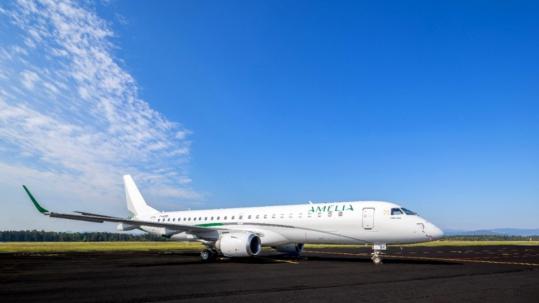
Airline Amelia and Thales announced the successful
large-scale deployment of their contrail-avoidance solution. This initiative,
launched in 2024 on Amelia flights between Paris and Valladolid (Spain) optimises
flight plans by modifying aircraft altitude rather than lateral trajectory to
avoid the formation of condensation trails (contrails). This reduces the
climate impact of each flight while limiting additional fuel consumption.
In 2025, Amelia deployed this solution across all
eligible flights, including Airbus A319/320 and Embraer ERJ-145 aircraft.
According to the climate-impact estimation models used, this avoided more than
2,000 tonnes of CO equivalent (CO2e) during 2025 and reduced the average
climate impact per flight by around 70 per cent. The initiative is part of
the DECOR project, supported by the France 2030 investment plan.
Contrails represent a significant but concentrated
share of aviation’s climate impact---about five per cent of flights generate up
to 80 per cent of this effect.
Far from purely
theoretical approaches, Amelia chose precision by focusing on ‘big hits’---the
rare flights where atmospheric conditions favour the formation of persistent
contrails with strong warming potential. Selecting these ‘big hits’ helps
account for the uncertainty associated with modelling the phenomenon by
concentrating avoidance efforts only on cases where the environmental benefit
is greatest. The results for 2025 included 2,000-2,500 net
tonnes of CO2 equivalent avoided after reanalysis using
state-of-the-art models, due to adjustments to flight plans; only 59
flights modified over the entire year, out of more than 6,400 flights
operated in 2025, were needed to achieve this result; controlled additional
fuel consumption.
The operational maturity of the solution
developed by Amelia and Thales, mainly involving adjusting altitude before
submitting the flight plan, facilitated its integration into Amelia’s flight
preparation process across all teams.
Says Adrien Chabot, director
of Sustainability, Amelia, “By targeting
high-impact flights, we remove the barrier of scientific uncertainty about the
magnitude of the phenomenon and focus on immediate action.”
The results were
analysed and verified by the scientific start-up Klima. Validation also
included spot checks using ground-based cameras with support from SII and
Reuniwatt, establishing a direct link between predicted avoidance and the
actual observation of contrails on Amelia flights and nearby flights. Says Yannick Assouad, executive vice president, Avionics, Thales. “This
success is part of Thales’ strategy: harnessing technology to accelerate the
transition towards more sustainable and responsible aviation. By integrating
contrail avoidance into flight-planning tools, we are demonstrating that
measurable climate benefits are possible at scale.”
Building on these results,
Amelia will continue deploying these solutions in 2026. The objective is to
encourage the systematic integration of non-CO2 impacts into
the aviation sector’s decarbonisation strategies and into preparations for
future European regulatory requirements.





 VIDEO
VIDEO