Research and development in the area of unmanned systems—on land, over and under sea, in air and in space—is progressing at a blazing pace and new systems are being deployed with each passing day. Unmanned Aerial Vehicles (UAV), also termed Unmanned Aerial Systems by some air forces and Remotely Piloted Aircraft (RPA) by some others, including the Indian Air Force, are proliferating by bounds. The term RPA may soon have to be modified as the increasing automation and autonomy being embedded in UAVs is removing the ‘remote pilot’ from the loop for some chunks of their mission, if not all. Ballistic missiles/vehicles, cruise missiles and artillery projectiles, while being unmanned and using the medium of the air, are excluded from the definition of a UAV.
Their increasing availability and low costs (in comparison to manned platforms) has rendered them objects of desire for not just militaries but also non-state and terrorist organisations for a vast number of roles in the battlefield and away from it (in urban warfare etc). The unarmed roles of UAVs include Electronic Warfare (EW), transportation and resupply, communication hubs, weather services, intelligence gathering, surveillance, reconnaissance, combat support, target acquisition and designation, battle damage assessment, special operations and casualty. A sub-set, Unmanned Combat Aerial Vehicles (UCAV), offers emerging roles like aerial combat, suppression of enemy air defences, strikes, manned-unmanned teams, air strikes (in the battlefield and beyond) and kamikaze (loiter and destroy) type missions where the UAV itself carries an integral explosive load and can guide itself to impact with high value targets.
UAV Evolution
Kamikaze UAVs have been making news in recent years but their history goes back to World War-I when the British Ruston Proctor Aerial Target was produced in 1916. It was remotely controlled with the help of revolutionary radio control techniques developed by Archibald Low, who was nicknamed ‘the father of radio guidance systems.’ The project was further modified for use of the platform in suicide strikes against Zeppelins. Another project was the British Hewitt-Sperry Automatic Airplane, varyingly known as the ‘Flying Bomb’ and the ‘Aerial Torpedo.’ It went from Britain to the US in 1917, resulting in an upgraded American version named the Kettering Bug. Although it was considered to be a large success, the war ended before it could be utilised.
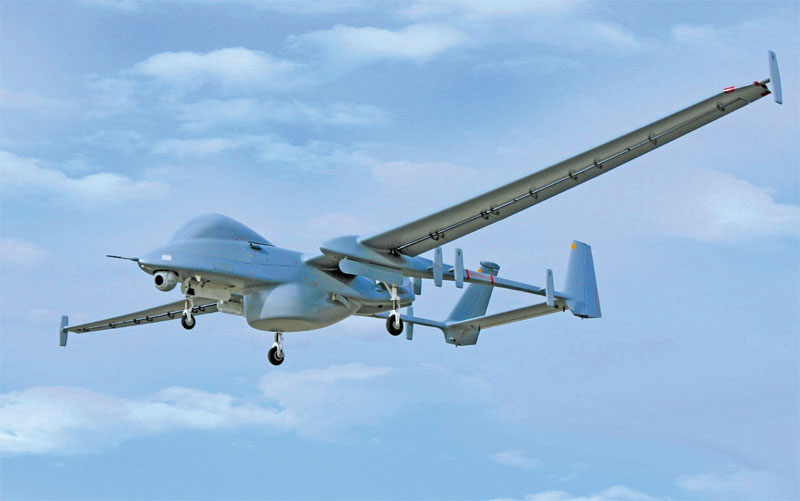
IAI’s Heron UAS
In the post-World War-II years, the value of UAVs for surveillance and reconnaissance was realised especially by the US, Russia and Israel. The US used UAVs in the latter part of the Vietnam War in the 1960s while Israel used UAVs (including loitering munitions) in the 1970s and 1980s against their Arab neighbours, Hamas terrorists in Gaza, Lebanon and the Palestinians. In the 1990s, UAVs were employed in the Gulf Wars, Afghanistan, Kosovo, Iraq and the Arab-Israeli wars. The surveillance role was predominant but precision strike roles soon gained prominence with the Predator family being armed with Hellfire missiles. Especially after the 9/11 attack, there was a rush to weaponise UAVs and the term UCAV gained prominence.








 VIDEO
VIDEO