

Aero India 2023 | Truncated Expo, Advantage HAL
Compared to its predecessors, the 14th Aero India expo was a heavily truncated event with the traditional static outdoor exhibits displaying only a few products developed by the ministry of defence-owned Hindustan Aeronautics Ltd (HAL) and Bharat Electronics Ltd (BEL). The foreign exhibitors had only a symbolic presence. This was due to the expo’s dates being announced only last October after the conclusion of the earlier-postponed Defexpo-2022 at Gandhinagar, Gujarat that same month, which had lavishly laid-out outdoor exhibits by the defence R&D organisation, BrahMos Aerospace, Larsen & Toubro, etc. And since HAL was nominated by the MoD to be the nodal agency for organising Aero India 2023, it used this opportunity to maximise public exposure of its military-technical/ military-industrial activities.
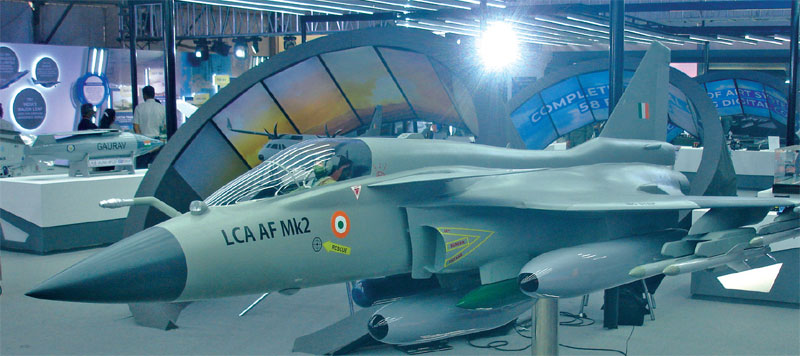
Tejas LCA Mk-2
Tejas Mk.1 Variants
The Indian Air Force (IAF), which presently operates two squadrons of the Tejas Mk.1 light multi-role combat aircraft (L-MRCA)—32 single-seaters and eight tandem-seaters--in February 2021 placed orders for 83 Tejas Mk1A L-MRCAs (73 single-seaters and 10 tandem-seaters) worth Rs 45,696 crore, with deliveries to commence next August at a rate of 16 per annum and concluding in 2029. Each single-seater will have an acquisition cost of Rs.309 crore (USD 42 million), while the tandem-seater will cost Rs.280 crore (USD 38 million).
About 85 private-sector vendors are involved in the production of Tejas Mk.1A with tier-1 enterprises including Bengaluru-based Dynamatic Technologies Ltd (front fuselage), Hyderabad-based VEM Technologies (centre fuselage), Adani Defence & Aerospace-owned and Bengaluru-based Alpha Tocol (rear fuselage), Coimbatore-based Larsen & Toubro or L & T (wings), while the tail-fin and rudder will be supplied by the National Aerospace Laboratory and Tata Advanced Materials Ltd.
As of date, 463 vendors are partnering for the project, including five tier-1 enterprises. Of the current vendors, 230 are in Karnataka and 131 of them are MSMEs. The indigenous content in the aircraft is presently about 52 per cent and the HAL is looking at ways to increase it in the raw materials to 65 per cent. Out of the Tejas Mk.1A’s 351 line-replaceable units (LRU), 191 have been indigenised through private-sector enterprises and defence public-sector undertakings such as the HAL and BEL, while out of the balance 156 LRUs, 91 are at various stages of indigenisation. Of these, more than 40 are the result of the MoD’s Technology Development Fund allocated by the MoD for MSMEs.
In August 2021, the HAL inked a Rs 5,375 crore (USD 716 million) contract with GE Aviation for the supply of 99 F404-GE-IN20 turbofans, each rated at 84kN thrust with reheat, along with support services to power the Tejas Mk.1As, while on December 16, 2021, the HAL signed a Rs 2,400 crore contract with the BEL for the development and supply of 20 types of LRUs. Imported items on the aircraft include the Quartz-built nosecone and a fixed in-flight refuelling (IFR) probe from UK-based Cobham, the active electronically scanning X-band EL/M-2052 multi-mode radar (AESA-MMR) from the ELTA Systems subsidiary of Israel Aerospace Industries (whose radar beam can move up to 60 degrees in any direction from the perpendicular: up, down, left or right), the EL/L-8222 Mid-band/high-band jamming pod, and the Targo helmet-mounted sight from Elbit Systems.
The first Tejas Mk.1A made its maiden flight early last May and is now undergoing 24 months of flight-testing. Like the Tejas Mk.1, the Mk.1A variant will be certified for a total technical service-life (TTSL) of 3,000 flight-hours or 30 years, with the time-between-overhauls being 1,500 flight-hours. With the NAL’s assistance, efforts are now under way to increase the L-MRCA’s TTSL to 5,000 flight-hours. The 13.5-tonne Tejas Mk.1A will have a maximum take-off weight (MTOW) of 13,500 kg, inclusive of a payload capacity of 3.5 tonnes and internal fuel capacity of 2,486 kg, giving an unrefuelled endurance of 57 minutes.
Subscribe To Force
Fuel Fearless Journalism with Your Yearly Subscription
SUBSCRIBE NOW
We don’t tell you how to do your job…
But we put the environment in which you do your job in perspective, so that when you step out you do so with the complete picture.




 VIDEO
VIDEO