A couple of years back defence minister Rajnath Singh said that a country that depended on military imports could never be strong, adding that being self-sufficient in the defence sector was linked to ‘self-respect’ and ‘sovereignty.’
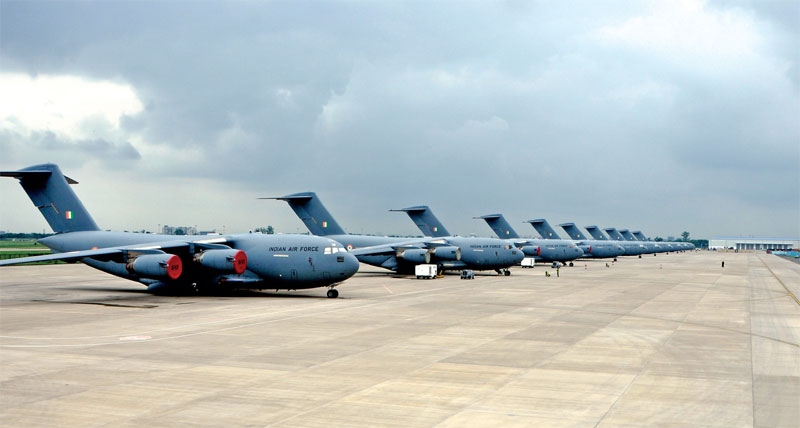
C-17
While India is actively publicising its intention towards becoming Aatmanirbhar, or self-reliant in defence, the country still relies heavily on foreign equipment. India continues depending on different countries for key technologies such as missiles, fighter jets, tanks, UAVs as well as engines. Even as efforts are being made by the local industry to step up manufacturing, India remains one of the largest importers of defence platforms.
A Stockholm International Peace Research Institute (SIPRI) report from 2022 stated that India accounts for 11 per cent of the global arms imports. Russia remains India’s largest defence partner, although this is slowly changing with India’s imports from France and the US increasing considerably over the past few years.
From Russian Shores
After Russia attacked Ukraine, India’s arms dependence on Russia became the focus of debate within the country and abroad. The three Indian service chiefs were faced with the question of how western sanctions on Russia would hamper India’s military preparedness. Experts mulled the impact on India, spoke of possible shortages as well as alternatives India could consider. The Indian defence manufacturing industry was brought into the limelight and Aatmanirbharta was deemed as a solution. The US saw an opportunity to wean India away from Russia and promoted its defence industry.
While India is turning towards the West, it is not yet possible to completely shut Russia out when it comes to procurements. India’s military relations with Russia will continue because of the country’s lack of investment in Maintenance Repair and Overhaul (MRO) facilities. While the Indian Air Force’s (IAF) in-house MROs have been equipped to maintain fleets of rotorcraft and fixed-wing aircraft, it is not possible for the force to cater to every aircraft present in the force. India and Russia have signed pacts to maintain some of the Russian-origin military equipment within the country.
For instance, in 2017, the two countries signed two key agreements for long-term maintenance and technical support for Russian-made Su-30MKI fighter jets of the IAF. The pacts were signed between India’s Hindustan Aeronautics Limited (HAL) and two Russian companies in the presence of the then defence minister Arun Jaitley and Russia’s industry and trade minister Denis Manturov. In November 2022, The Hindu reported that the single squadron of Mi-35 attack helicopters in the IAF were undergoing a complete overhaul in Russia to extend the lifespan of these helicopter by six years. The overhaul is being undertaken in two batches and it should be completed by mid-2023.
Similarly in 2019, the Mi-26 helicopters were also required to fly back to Russia for overhaul. The IAF operated two squadrons of the older Russian Mi-25/35 attack helicopters, of which one squadron has been phased out following the induction of 22 Boeing AH-64E Apache attack helicopters in 2019-20. Of the 500 helicopters that the IAF operates, 90 are Mi-17s, 130 are Mi17 Vs and the one squadron of Mi-35 attack helicopters, all of which are of Russian origin. India also operates Mi-26 heavy-lift helicopters and Kamov anti-submarine warfare helicopters. The rest include Advanced Light Helicopters (ALH), including the Rudra variant, AH-64E Apache attack helicopters and CH-47F Chinook heavy lift helicopters.





 VIDEO
VIDEO