In the 21st century, the Indian Navy emerged as the fifth largest navy in the world, extending its reach to the farthest corners of the Indian Ocean Region (IOR). With its growing sea assets, the Indian Navy has become a dominant force in the IOR. Keeping that in mind, India’s Maritime Capability Perspective Plan envisages a 200-ship fleet by 2027 to guard the nation’s enormous coastline from all kinds of threats. The force, which currently has over 137 ships and submarines under its command, has speeded up acquisitions of warships, while building a formidable indigenous capability back home.
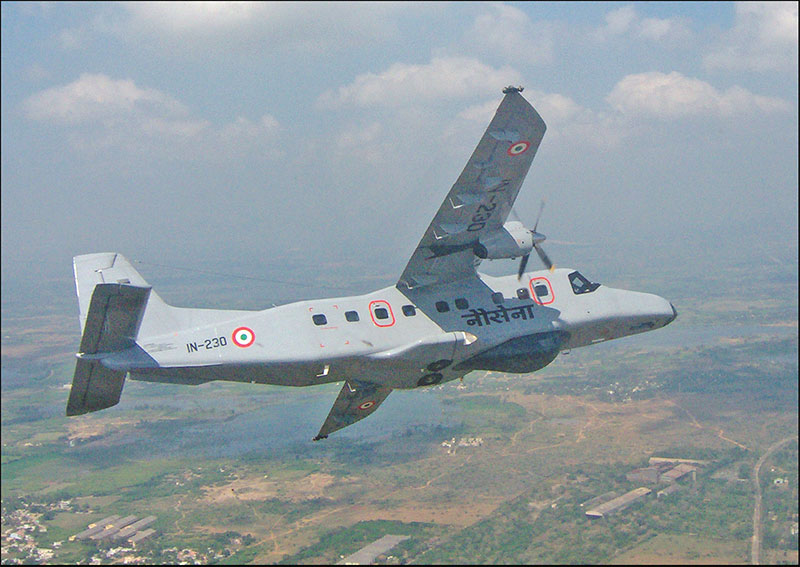
Indian Navy’s Dornier aircraft
India sees itself as the net security provider in the region. However, IOR is witnessing an unprecedented spurt in the presence of navies from countries like China, which is aggressively building its naval capabilities. As such, enhancing vigilance in its seas has become more important than ever for India. The country, therefore, needs to strengthen its maritime reconnaissance capabilities, which is constantly evolving, and now includes anti-submarine warfare (ASW), anti-surface warfare, anti-ship, intelligence, surveillance, and reconnaissance gathering. The role of aircraft becomes paramount when it comes to maritime reconnaissance and surveillance, as they take advantage of the height, speed and range to offer an unblemished imagery of the concerned area.
The Indian Navy has different categories of such assets, which includes fixed-wing and rotary wing aircraft. In terms of fixed-wing assets, the spectrum of surveillance and reconnaissance includes long-range maritime reconnaissance (LRMR), medium-range maritime reconnaissance (MRMR), and short-range maritime reconnaissance (SRMR).
LRMR
The Boeing P-8I long-range maritime surveillance and anti-submarine aircraft has played a prominent role in the Indian Navy, and the force has constantly increased the fleet of these aircraft. The Indian Navy already has eight P-8Is in service, which were first delivered by Boeing in 2013. The order for four more was given in 2016. The Indian Navy has now reportedly given the go-ahead to six more P-8I aircraft, which will take the fleet size to 18 by 2020-21, when the final order of six aircraft is expected to be delivered.
Boeing is optimistic about its partnership with the Indian Navy and has offered top of the line assets to the force. The company’s India managing director, Surendra Ahuja, said, “Boeing has been a strong partner in mission readiness and modernisation of India’s defence forces. We’re grateful to partner with the Indian Navy to secure the country’s maritime interests with the P-8I that is capable of maritime surveillance, anti-submarine, anti-surface warfare and search and rescue operations. The P-8I has demonstrated an excellent record in supporting the missions they have been deployed for and has surpassed close to 25,000 flight hours since their induction in 2015.”








 VIDEO
VIDEO