

A Year Later
Op Sindoor sent out a message of resolve, credibility, and deterrence—a necessity in today’s conflicts
 Air Cmde T.K. Chatterjee (retd)
One year ago, a single act of terror in the quiet valleys of Pahalgam jolted the subcontinent into a reckoning. India’s response—Operation Sindoor—was swift, decisive, and unprecedented in its precision. What followed was not a prolonged war but a brief, intense confrontation that reshaped military thinking, strategic signaling, and regional deterrence. As the echoes of that operation continue to influence policy and preparedness today, this article examines whether Operation Sindoor prompted doctrinal and other changes in the Indian armed forces.
Doctrinal Change
In the December 2025 issue of FORCE, under the title ‘Widen the River’, I had strongly criticised the idea of Theatre Commands in our armed forces. To the Indian Air Force (IAF), the concept was a solution in search of a problem. I had argued that ‘…Theatre Commands are a geographic necessity. When the area of influence is huge, and the country has abundant resources, it becomes necessary to create separate, independent fighting machines with land, sea, and air assets.’ India is nowhere near this situation. So, in our context, the creation of Theatre Commands is just a pretext for the Indian Army and Indian Navy brass to usurp IAF assets and expand their own domains.
Operation Sindoor proved that decisive limited wars with clear-cut objectives can be fought primarily with air power, supported by ground and naval assets, while remaining below the nuclear threshold. Has this concept brought about any doctrinal changes? Possibly. It was reported by The Print on 8 April 2026 that, as per informed sources from within the service headquarters, the Theatre Commands are being restructured, with the Western Theatre, facing Pakistan, to be commanded by an IAF three-star officer, as against the earlier proposal of all land-based Theatres being commanded by army three-star officers. If accurate, this is a rational correction because most conflicts with Pakistan, even in the future, are likely to be fought primarily with air assets.
Procurement Policy Realignment
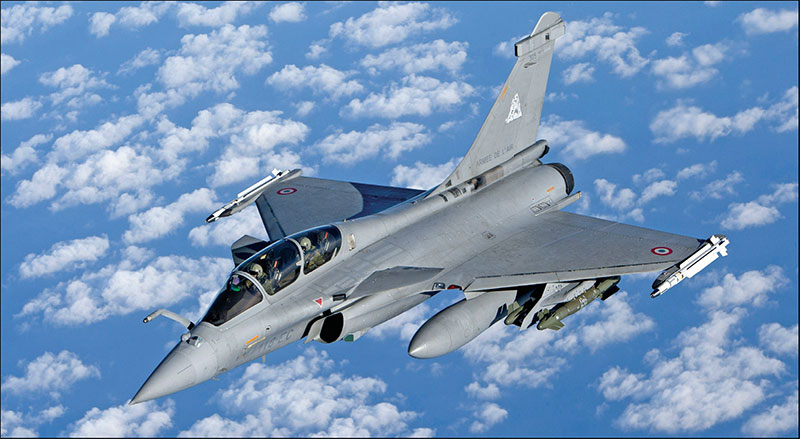
In the aftermath of Operation Sindoor, India’s procurement policy has rightly undergone a visible realignment, with a clear tilt toward strengthening its airborne combat and surveillance capabilities. Central to this shift has been the decision to substantially augment the fighter fleet through the purchase of 114 Rafale aircraft from France, signaling confidence in proven, multi role platforms capable of delivering precision effects.
Additionally, drawing directly from operational lessons, the Indian Army invoked emergency procurement powers to place confirmed orders worth over Rs 5,000 crore for unmanned aerial systems, marking one of the largest and fastest drone acquisitions in its history. These include hundreds of indigenous loitering munitions, hybrid and VTOL surveillance Unmanned Aerial Vehicles (UAVs), and short-range armed drones, alongside follow-on purchases of Medium Altitude Long Endurance (MALE) platforms such as the Heron Mk-II. Conducted after intensive trials in jamming- and spoofing-heavy environments, these procurements signal a decisive shift: unmanned systems are no longer auxiliary assets, but central to India’s doctrine for limited conflict below the threshold of full scale war.
Intelligence Lessons
Accurate and timely intelligence is a prerequisite for any force going into battle. Without it, the likelihood of the force getting surprised, in the air, on the ground, or at sea, is very high. Though neither the Indian government nor any of our major arms suppliers confirmed any losses during the conflict, the international media carried persistent reporting about the Indian losses on the first night of the conflict. A report by The Week on 3 August 2025 on the claimed downing of a Rafale jet said: ‘However, a recent Reuters report claimed that the problem was not with Rafale, but an intelligence failure concerning the range of the China-made PL-15 missile, which resulted in the downing of the aircraft.’
While some similar post-operation reporting raised questions about tactical intelligence assessments—particularly relating to adversary missile capabilities—there was no public acknowledgment of systemic intelligence failure. Official statements treated losses as inherent to combat, and the larger intelligence architecture behind Operation Sindoor was not called into question. It is the task of the Indian embassies around the world to keep track of who gets what, from whom, and when, rather than relying solely on Janes to report on them, especially when it comes to our existing and potential adversaries. Incorrect or delayed information leads to avoidable losses in battle. This is a lesson that the Indian armed forces and our intelligence community have probably absorbed the hard way.
Information Warfare
Modern conflicts do not end with the last bullet fired. In the aftermath of Operation Sindoor, multiple studies and policy analyses concluded that the conflict rapidly shifted from the kinetic to the cognitive domain. An Observer Research Foundation (ORF) assessment described Sindoor as ‘military precision in the service of political messaging,’ arguing that India recognised that ‘the side that frames the question often controls the answer’ in limited conflicts under a nuclear overhang.
The Vivekananda International Foundation (VIF) noted that Pakistan achieved early perceptual advantage through rapid media access and ‘calibrated victimhood messaging,’ while India’s communication was initially reactive rather than doctrinal. Reflecting institutional learning, Indian Army commentary later acknowledged that Operation Sindoor marked a watershed in which ‘approximately 15 per cent of operational time was devoted to countering fake narratives and disinformation,’ indicating that narrative control had become a core operational concern rather than an auxiliary activity.
Overall, the narrative and information control were markedly better than the Balakot 2019 episode. The Battlefield Damage Assessment (BDA) evidence put forward by Indian forces proved without doubt the damning effects of Indian strikes on Pakistani military and state-sponsored terrorist assets.
A point of contention was the necessity of sending batches of Indian parliamentarians around the world, post-conflict, to explain the Indian perspective on the operation. International media ignored this effort altogether. It would probably make more sense to take such an action before the conflict. In the India-Pakistan scenario, surprise will not be lost if Indian action is in response to any Pakistan-sponsored terrorist activity, since Pakistan knows an Indian reaction will happen, except not when, and in what manner.
On the domestic front, the performance of Indian television media was, frankly, embarrassing. Too often, it did not report the war; it produced theatre. Some channels competed to ‘capture’ Pakistani cities. This is not merely sensationalism—it is informational self-harm. The ministry of defence’s public relations machinery must maintain structured liaison with media networks and actively counter both adversary disinformation and irresponsible domestic misinformation.
Integration Challenges
Battle space in today’s warfare is littered with innumerable space, air, and surface-based systems. To achieve cohesion among them, a secure data link connecting all platforms is a must. To create a true net-centric force, the sensors, shooters, and decision-makers must act as a single entity. Indian forces face a difficult situation in this regard because we procure our weapons and systems from far too many different sources. It gives us capability and political flexibility, but creates integration issues. An Indian made fighter aircraft using an Israeli radar and French missiles is bound to have profound integration challenges. Add to it when it tries to talk to a Russian or any other air and ground elements procured from equally divergent sources, each with its own data standards, protocols, encryption schemes, and sovereign ‘black box’ controls.
In multinational systems, data often passes through multiple translation layers, causing latency and increasing the risk of data loss. These issues impose severe penalties for real-time information sharing, adversely affecting the overall efficiency of the force. Overcoming this is a formidable task. Armed forces engineers, Defence Research and Development Organisation (DRDO) elements, and other related public and private-sector agencies are doing an amazing job of it. But Operation Sindoor showed that much more remains to be done.
Chinese Shadow War
A stark lesson learned from this conflict is that when India confronts Pakistan in the future, it will not be Pakistan alone that Indian armed forces will be engaging. China’s shadow on the conflict will be very much visible. A Carnegie Endowment assessment observed that ‘China is becoming increasingly more involved, though indirectly, through its aid to Pakistan,’ highlighting how Beijing’s role now shapes even short duration Indo Pak crises.
Writing for the ORF, Harsh V. Pant and Rahul Rawat argued that ‘the China Pakistan military partnership… was visibly reinforced during Operation Sindoor,’ noting the operational use of Chinese origin fighter jets, PL-15 missiles, drones, and Intelligence, Surveillance and Reconnaissance (ISR) support as evidence of a maturing military synergy. This assessment was echoed publicly by India’s Deputy Chief of Army Staff, Lt Gen. Rahul R. Singh, who stated that “China was an ever-present factor bolstering Pakistan’s military efforts through unprecedented battlefield collusion during Operation Sindoor,” marking a departure from earlier wars where Beijing remained a background player. As The Hindu noted, China’s posture was ‘distinctly more layered and collusive,’ leveraging ISR, defence-industrial support, and diplomatic signaling to reinforce Pakistan without overtly crossing red lines. The implication is clear: future conflict with Pakistan will unfold within a de facto two front strategic environment, where Chinese systems, intelligence, and political backing shape the battlefield—even if the People’s Liberation Army (PLA) never fires a shot.
But China is not the only enabler. Pakistan increasingly operates within external security umbrellas—earlier China, now selectively the Gulf. It has entered into a Strategic Alliance with Saudi Arabia and has logistical support from Turkiye. While neither Riyadh nor Ankara will fight Pakistan’s wars, yet both will provide material support and political backing in future conflicts with India. For Indian doctrine, the implication is clear: future operations against Pakistan must be swift, decisive, and time compressed, achieving unambiguous military and political outcomes before external actors can shape mediation or perception.
Conclusion
One year after the quiet valleys of Pahalgam were shattered by terror, the significance of Operation Sindoor lies not merely in what was struck, but in what was signaled. India’s response—swift, precise, and limited—demonstrated that restraint need not imply passivity, and that calibrated force can restore deterrence without inviting catastrophe. Sindoor showed that India can act decisively even under the shadow of nuclear weapons and external enablers, managing escalation while imposing unmistakable costs. In doing so, it was unmistakably conveyed: terrorism would no longer find automatic sanctuary behind proxies, narratives, or third party mediation. The legacy of Operation Sindoor, therefore, is not a fleeting exchange of fire, but a clear message that endures—a message of resolve, credibility, and deterrence framed for the realities of contemporary conflict.
While we congratulate the Indian armed forces for an excellent performance, the operation also exposed certain limitations. Some of them are being rectified, while some others will require systemic changes. The more self-reliant India becomes in the defence-industrial ecosystem, the more efficient it will be in executing a multi-domain net-centric conflict. Then, in the next round of conflict, the verdict of think tanks would be more telling than what the Royal United Services Institute (RUSI) in an article on 21 May 2025 said about Operation Sindoor—‘Operation Sindoor should be remembered not as a dogfight between airframes, nor as a stumble toward strategic instability. It was a calibrated use of force, intended to signal resolve, degrade terrorist infrastructure, and demonstrate capability—without crossing the line into broader war.’



 VIDEO
VIDEO