The IAF’s need for a steady stream of trained pilots is now greater than ever before as it is faced with maintaining a high-tempo operational posture on the country’s western and northern borders. By the end of this decade, the IAF would have largely overhauled its entire training infrastructure with a strong focus on simulators and the ability to have them operate in concert with one another, regardless of their geographical location.
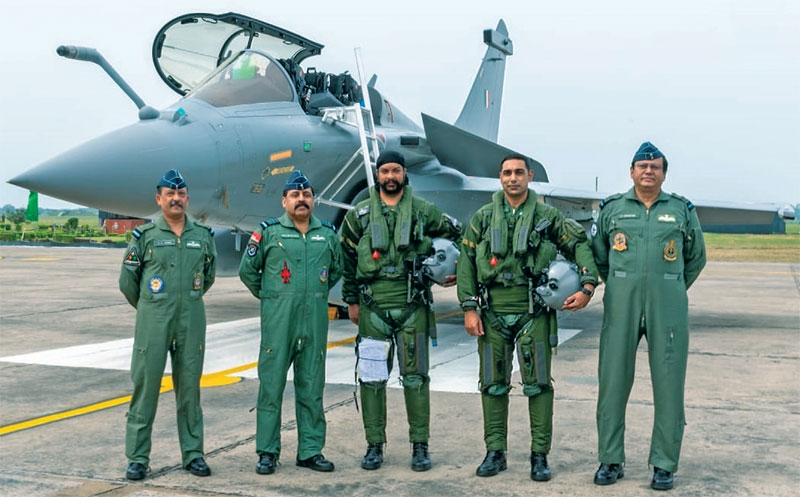
Air Marshal R.K.S Bhadauria posing with then AOC-in-C Western Air Command, Air Marshal B Suresh with the pilots of the first Rafale to arrive in India
Air Marshal R.K.S Bhadauria posing with then AOC-in-C Western Air Command, Air Marshal B Suresh with the pilots of the first Rafale to arrive in India[/caption]
The IAF is at the forefront of induction of state-of-the-art training systems and simulators across all three services and while there remain challenges related to basic training (FORCE, August 2021), the induction of modern fixed-wing and rotary-wing types has brought with it a strong emphasis on simulator-based training.
Thrust Towards Simulation
The IAF in all its recent aircraft and helicopter procurements has made it mandatory to include Fixed Base Full Mission Simulators (FBS), Cockpit Procedure Trainers (CPT), Avionics Part Task Trainer (APTT), Flight Training Devices (FTD) and Computer-aided learning systems.
While simulation-based training has been incorporated in growing numbers with the induction of training aircraft such as the BAE Systems Hawk Mk132 and Pilatus PC-7 MKII over the past decade, it is the induction of the Rafale F3-R which has brought with it the greatest change to the IAF’s training infrastructure for operational squadrons. Other new platforms such as the C-17 Globemaster III, AH-64 I, CH-47D from Boeing and Lockheed Martin C-130J Super Hercules have also modernised the way the IAF trains its operational pilots.








 VIDEO
VIDEO