

A Reality Check
SAARC is not a bilateral India-Pakistan forum; it is a multilateral institution
 Bhim Bhurtel
The spring of 2025 produced two instructive contrasts in how nations handle great power pressure. When US President Donald Trump deployed tariffs as a strategic weapon, China’s response was studied indifference. Beijing did not call Washington; Washington eventually called Beijing. Beijing had correctly calculated that its deep integration with neighbouring economies and control of key nodes in global value chains gave it sufficient cushion to absorb American pressure—and sufficient leverage to wait the other side out.
India’s response was rather different. Prime Minister Narendra Modi, who had not been invited to Trump’s inauguration, flew to Washington in February and accepted a 19 per cent tariff regime without extracting any meaningful concession in return. One country negotiated from a position of strength. The other did not, because it had spent a decade ensuring that it had none.
This asymmetry is not accidental. It is the direct consequence of a strategic decision India took nearly a decade ago: The deliberate paralysis of the South Asian Association for Regional Cooperation (SAARC) following the Uri terrorist attack in September 2016. What Indian policymakers celebrated at the time as principled isolation of Pakistan has since revealed itself as something far more damaging—the self-amputation of India’s most important source of regional leverage. The surgery was performed in anger, perhaps at the advice of Western strategists and a cohort of Indian diplomats who confused short-term political optics with long-term national interest. India is still paying the bill.
The Forum India Built, Then Buried
SAARC was established in Dhaka in December 1985, uniting eight nations—India, Pakistan, Bangladesh, Nepal, Sri Lanka, Bhutan, the Maldives, and, later, Afghanistan—in a shared framework for economic cooperation, connectivity, and free trade. Given its size and economic weight, India was the natural anchor of the bloc. The 2004 Islamabad summit produced SAFTA, the South Asian Free Trade Area, which seemed to promise an economic trajectory comparable to Association of Southeast Asian Nations (ASEAN) or even an embryonic European Union (EU).
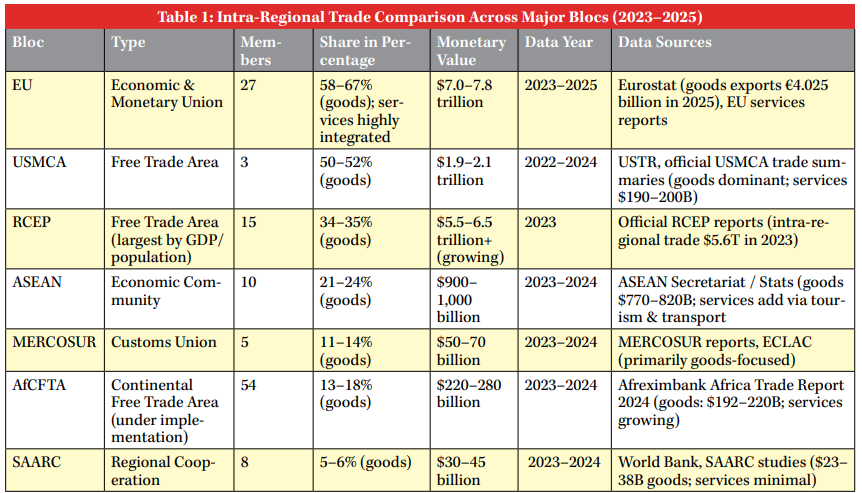
It never arrived. India consistently chose to view SAARC through a security lens rather than an economic-integration lens, treating the forum primarily as an instrument for containing Pakistan rather than for integrating a market of 1.8 billion people. The results were predictably dismal. After four decades, intra-SAARC trade amounts to a mere five to six per cent of members’ total trade—a figure that compares scandalously with ASEAN (21-24 per cent), Regional Comprehensive Economic Partnership (RCEP) (34-35 per cent), or the EU (58-67 per cent). The table below is a portrait of strategic failure.
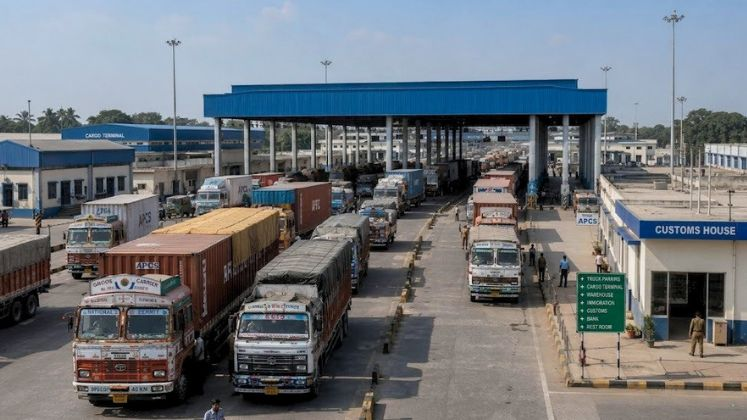
THE LAST GASP Prime Minister Narendra Modi addressing the inaugural session of the
18th SAARC Summit in Kathmandu, Nepal on 26 November 2014. No summit was held after that
India appears to assume it can export goods and services to all SAARC nations while restricting imports from other member states. Sustainable trade cooperation within SAARC, however, requires India to engage in reciprocal trade arrangements.
The Uri Decision and Its Consequences
On 18 September 2016, militants killed 19 Indian soldiers at a military base in Uri in Jammu and Kashmir. The attack was deplorable; Pakistan’s role, at minimum through permissive tolerance of militant groups, was reasonably inferred. India’s response was to boycott the 19th SAARC Summit in Islamabad and, in effect, to shut down the entire process indefinitely. The slogan was crisp—‘Terrorism and dialogue cannot go together’—and politically convenient. It was also strategically catastrophic.
The fundamental error was a categorical mistake. SAARC is not a bilateral India-Pakistan forum. It is a multilateral institution serving Nepal, Bangladesh, Sri Lanka, Bhutan and the Maldives—countries with their own connectivity requirements, trade grievances and development aspirations entirely unrelated to the dispute over terrorism. By holding the entire regional architecture hostage to a bilateral quarrel, India did not punish Pakistan. Pakistan had no particular stake in SAARC’s functionality. India punished everyone else, including itself.
The BIMSTEC Illusion
India’s response to criticism of this position was to promote the Bay of Bengal Initiative for Multi-Sectoral Technical and Economic Cooperation (BIMSTEC) as an alternative regional forum. The architects of this substitution—among them the then foreign secretary and current external affairs minister S. Jaishankar, working in alignment with the US Indo-Pacific strategy—presented BIMSTEC as a Pakistan-free, China-resistant vehicle for South Asian integration. The case was always thinner than it appeared.
Three deficiencies doom the BIMSTEC hypothesis. First, geography: BIMSTEC excludes Pakistan, Afghanistan, and the Maldives—a third of South Asia’s population and a significant share of its economic mass. Claiming to represent South Asian integration while excluding a third of the region is not a regional strategy; it is a residual coalition. Second, mandate: BIMSTEC was conceived as a mechanism for Bay of Bengal littoral cooperation, not as a vehicle to address South Asia’s defining challenges—extreme poverty, Himalayan climate risk, food insecurity, and missing infrastructure. It lacks both the institutional capacity and the political legitimacy to serve that purpose. Third, membership coherence: the inclusion of Myanmar, mired in civil war and military dictatorship, and Thailand, whose primary economic orientation is toward ASEAN, makes BIMSTEC’s claim to South Asian relevance increasingly fictional. India sacrificed its only genuine regional platform for a forum that has neither the architecture, the resources, nor the ambition to replace it. BIMSTEC’s secretariat budget and policy clarity remain derisory by comparison with even the most rudimentary regional organisations. The whole enterprise has the flavour of a diplomatic sand castle—impressive at a distance, hollow on inspection.
What Integration Would Have Been Worth
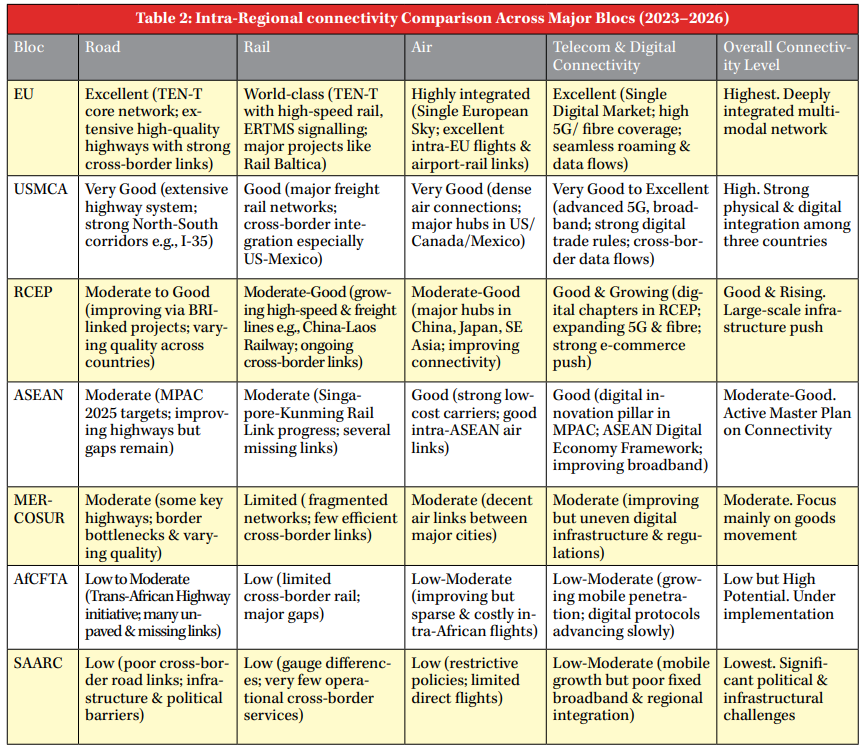
The opportunity cost of India’s regional policy failure is calculable, if sobering. Had intra-SAARC trade reached ASEAN levels, the bloc’s internal market would today be worth USD 3.5- 4 trillion. That figure would have transformed India’s negotiating position in every global trade dispute, including its humiliating encounter with recent Trump’s tariffs. It would also have offered the region the connectivity infrastructure it conspicuously lacks.
Five Strategic Dividends India Forfeited
A credible multilateral bloc would have provided five strategic assets India conspicuously lacks today.
First, bargaining power: A unified South Asian market of 1.8 billion people, with USD5.8 trillion GDP and more than USD25 trillion in GDP PPP terms, integrated into trade, would have given India the same capacity China demonstrated in 2025: the ability to absorb external economic pressure without capitulating to it. India’s unilateral surrender on tariffs was not an accident of diplomacy—it was the predictable outcome of choosing economic isolation.
Second, peer status with China: India’s EAM Jaishankar has complained, in various forums, that China does not treat India as an equal. The more pertinent observation is that China earned its negotiating position by integrating its neighbourhood economically through ASEAN partnerships, Central Asian investment, and the Belt and Road Initiative (BRI). India declined to do the same. A genuinely integrated South Asia would have given India the regional weight to claim peer status; a fragmented one does not.
Third, authentic regional leadership: With the exception of Bhutan, no South Asian government currently regards India as a reliable partner of choice; rather, it sees India as a necessity. Successive governments in Nepal, Bangladesh, Sri Lanka, and the Maldives—regardless of their ideological complexion—have sought strategic or economic hedges through China. This is not anti-Indian sentiment in the abstract; it is a rational response to Indian behaviour. An active multilateral forum would have provided a mechanism to manage disputes over borders, water resources, and trade grievances in a structured, rules-based setting—reducing the bilateralism that so often devolves into coercion.
Fourth, strategic autonomy: India aspires to ‘strategic autonomy’ as a foreign policy doctrine. The claim is undermined by the absence of any alternative economic foundation. China’s ability to resist American pressure rests on its domestic market depth and its integration with neighbouring economies and ASEAN. India’s current posture—security partner to the Quad, supplicant on trade—reflects not autonomy but dependence. A strong regional bloc would have converted rhetorical autonomy into something substantive.
Fifth, people-to-people integration: Had it been allowed to function, SAARC would have gradually built cross-border networks of trade, education, culture, and travel that would have reduced the ambient hostility generated by India’s coercive episodes. Visa liberalisation, academic exchanges, and common standards would have made smaller nations stakeholders in Indian prosperity rather than resentful observers of Indian hegemony.
Nepal’s Unresolved Grievances
As SAARC’s founder member and the permanent host of its secretariat, Nepal has particular standing in this argument—and particular cause for frustration. Its complaints are not rhetorical. They are documented, specific, and stubbornly unresolved.
Border disputes rank first. India stations troops in Limpiyadhura, Lipulekh, and Kalapani—territories Nepal regards as its own. In 2019, India published a political map including those areas; in 2020, it unilaterally inaugurated a road through Nepali territory to connect Tibet with the Mansarovar pilgrimage site. Nepal amended its constitution to reflect its own cartographic position. India has not responded to requests for high-level talks.
The 1950 Peace and Friendship Treaty, which Nepal considers unequal, constrains its sovereign right to purchase weapons without Indian consent and links its security arrangements to Indian preferences. A joint Eminent Persons Group produced a report recommending revisions; Prime Minister Modi has declined to release it.
Economic coercion has been the most visceral grievance. India imposed an undeclared blockade for 15 months in 1989 and again for six months in 2015—the latter during the immediate aftermath of a devastating earthquake, when Nepal was dependent on imported medicines, fuel, and infant formula. Whatever the diplomatic justification, the image of a large democracy blocking baby milk to a neighbour in the midst of a natural disaster has not faded. Since 2015, India has raised technical or administrative barriers to Nepali exports on over 160 separate occasions.
River treaties are a further irritant. Nepal regards the Mahakali (1996), Koshi and Gandak agreements as instruments that transferred control of its major rivers to India, yielding India billions of dollars in irrigation and flood-control benefits while leaving Nepali farmland subject to periodic inundation when upstream gates are opened without notice. And Nepal has been subjected to sustained pressure to embrace the BIMSTEC agenda as a replacement for SAARC—a substitution it has not accepted.
The Nepali diplomatic community’s verdict is blunt. India subordinated the logic of shared regional prosperity to narrow security calculations, then compounded that error by treating smaller neighbours as subjects to be managed rather than partners to be engaged. “India forced us to walk behind it,” as one Kathmandu diplomat has put it. “It never invited us to walk with it.”
The Path Back
The geopolitical lesson of the past decade is clear enough. No country sustains global influence by impoverishing and alienating its immediate neighbourhood. China’s rise as a diplomatic counterweight to the US was built not on military capacity alone but on economic integration—turning its region into a constituency that has a material interest in Chinese stability and prosperity. ASEAN countries trade heavily with China; Central Asian states depend on Chinese infrastructure investment; BRI linkages bind dozens of economies to Beijing’s preferences. India has done the opposite, and its vulnerability to external economic pressure—not only from Washington but from any sufficiently determined actor—is the predictable result of that choice.
The case for reviving SAARC is not sentimental nostalgia. It is a hard-headed strategy. A reinvigorated SAFTA, functioning integrated check-posts, liberalised aviation, and genuine cross-border energy and infrastructure investment would generate the internal market that India needs to negotiate on equal terms with any external power. The institutional scaffolding already exists. SAARC’s secretariat remains in Kathmandu. Its legal and institutional architecture is intact. The accumulated body of treaties, working groups, and technical agreements does not need to be rebuilt from scratch. What is missing is Indian political will, and specifically the willingness to decouple the institution’s functionality from the bilateral temperature with Pakistan.
The alternative is a continuation of the present trajectory: a South Asia that remains the world’s least integrated region, a collection of suspicious bilateral relationships managed through periodic coercion rather than a functioning and rules-based multilateral framework. China will continue to fill the vacuum that India is reluctant to occupy—offering infrastructure finance, port concessions, and trade agreements to countries that India treats as subordinates rather than partners. India’s strategists have for years invoked a ‘neighbourhood first’ doctrine. A decade of evidence suggests the phrase has described an aspiration that has never been operationalised—and in the most consequential cases, has been actively contradicted by policy. Whether India chooses to make it real before the window closes and the region’s economic alignment takes a direction unfavourable to New Delhi is the defining regional question of the coming decade. While India is considered a middle power globally, it holds a leading position in South Asia and carries significant regional responsibilities. As Winston Churchill stated, “The price of greatness is responsibility.” History tends to be unforgiving of powers that mistake tactical victories for strategic wisdom.
(The writer served as executive director of the Nepal South Asia Centre, a Kathmandu-based South Asian think tank, from 2008 to 2014, and as a columnist for the Hong Kong-based Asia Times. He currently teaches Global Political Economy in the Master's Programme)





 VIDEO
VIDEO