

A New High
After the recent two-day jamboree (February 24 and 25) of President Donald Trump to India, relations between India and the United States have been elevated to Comprehensive Global Strategic Partnership (CGSP). This is significant. How much the CGSP delivers would depend on two factors.
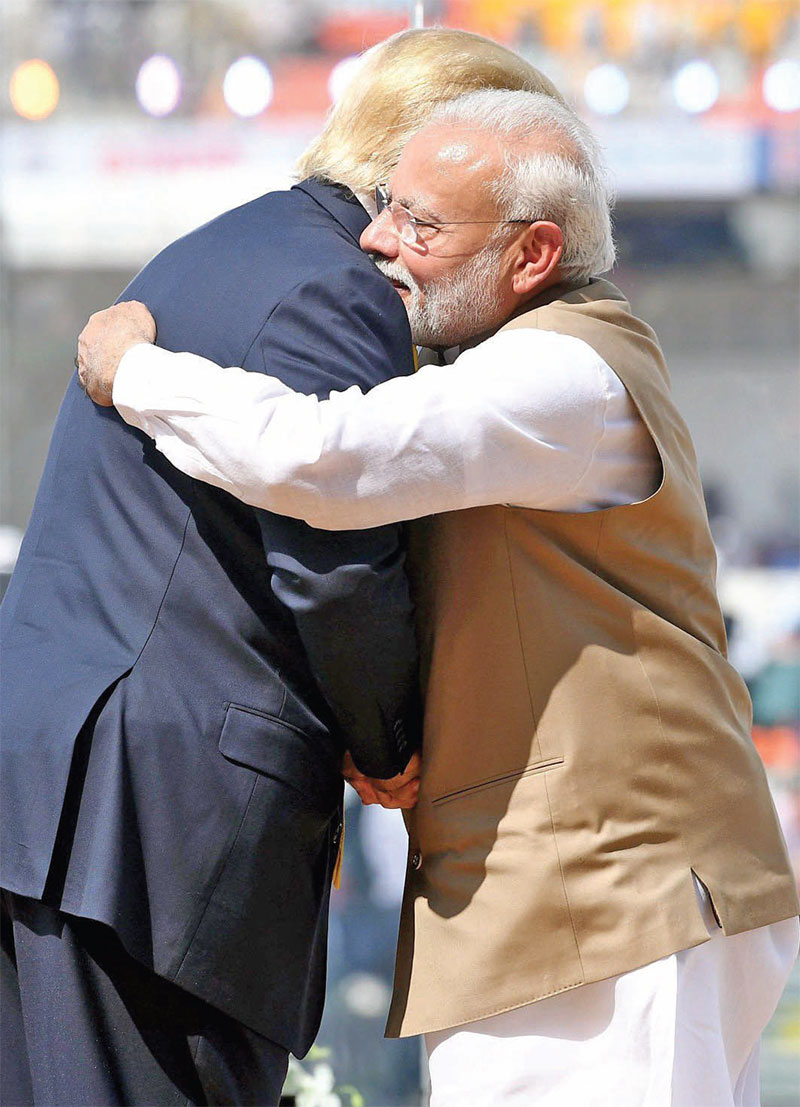
Prime Minister Narendra Modi and US President Donald Trump
One, India’s acceptance of US’ Blue Dot Network proposal discussed during the Trump visit as a purported answer to China’s Belt and Road Initiative (BRI). Accepting it could result in India taking a hardened position on possibility of cooperation with China’s BRI through the Wuhan understanding of India-China-Plus mechanism; and Two, strategic trust, which remains wobbly.
What is equally important from CGSP’s perspective is the distance the two sides have traversed since 1991 when the US Lt Gen. Claude M. Kicklighter visited India to explore military cooperation. The outcome of 29 years of bilateral relationship, with its ups and downs, is expected to give political, security, defence and military fillip to the elevated partnership.
Traditional wisdom informs that India, under Prime Minister Narendra Modi would likely invest wholeheartedly in the CGSP since the strategic fraternity believes that closeness with Washington deters China. There has been little basis to support this thesis especially after the coming of the fifth-generation leadership under general secretary Xi Jinping in China in November 2012. Another reason for comfort with the US has been the absence of the Soviet Union. Despite chanting the mantra of strategic autonomy, India has, since Independence, always carved a regional role for itself under the benediction of a global power. In the present century, the US has replaced the Soviet Union.
The bilateral cooperation, however, would have remained an unconsummated marriage, had the US not taken the lead by inserting substance into the CGSP which addresses the regional Free and Open Indo Pacific strategy. The reason for this half-hearted outreach has been India’s unwillingness to publicly identify China as the source of its strategic and military quandary. Consequently, India’s strategic dilemma, overtime, would have increased not diminished as BRI would have crept closer home into South Asia.
To place the CGSP into perspective, there is a need to step back. On 30 May 2018, the Trump administration renamed its Pacific Command as the Indo-Pacific Command to signal the centrality of India. This was a quantum jump from the US’ Bush administration’s reference to India in March 2005 as the net security provider in the Indian Ocean Region (IOR) — a phrase that Indian admirals have been unable to understand in quantifiable military terms. The region spanning the two oceans — Western Pacific and Indian — which is the responsibility of the Indo Pacific Command too got a new name: Indo Pacific region.
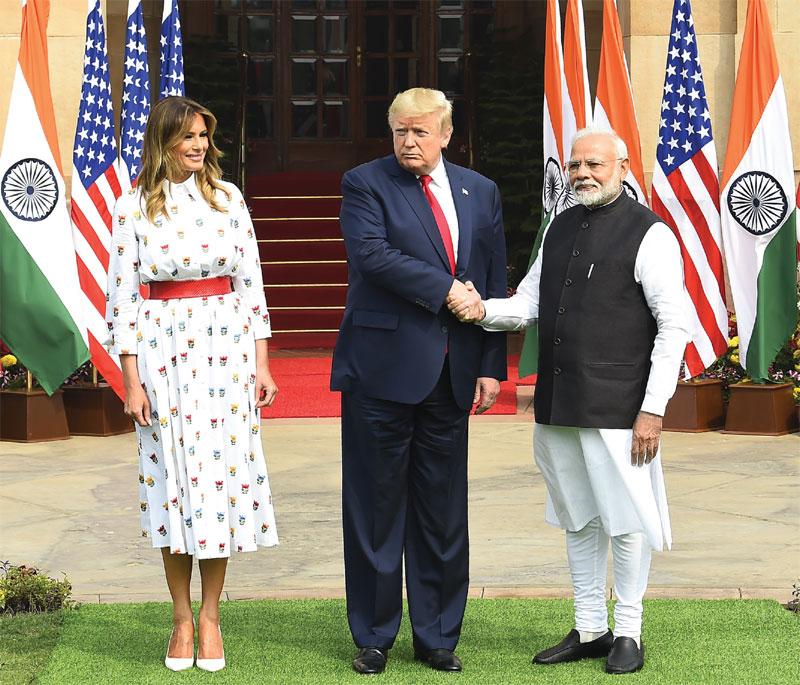
PM Modi and President Donald Trump with US First Lady Melania Trump
The stage was set for the geostrategic clash of the century between the US-led Indo Pacific strategy and the China- (and Russia) supported Asia Pacific strategy. The Modi government’s acceptance of the CGSP would suggest bolder Indian participation in the Indo-Pacific strategy. This is a big deal since the US appears to have got India onboard its strategy without naming China — the target of its strategy.
According to the joint statement issued after the Trump visit: ‘Prime Minister Modi and President Trump decided to strengthen consultation through the India-US-Japan trilateral summits; the 2+2 Ministerial meeting mechanism of the Foreign and Defence Ministers of India and the United States; and the India-US-Australia-Japan Quadrilateral consultations, among others. Prime Minister Modi and President Trump looked forward to enhanced maritime domain awareness sharing among the United States, India, and other partners.’
Subscribe To Force
Fuel Fearless Journalism with Your Yearly Subscription
SUBSCRIBE NOW
We don’t tell you how to do your job…
But we put the environment in which you do your job in perspective, so that when you step out you do so with the complete picture.



 VIDEO
VIDEO