Unmanned Aerial Vehicles (UAVs) have emerged as game-changers in modern warfare. Yet, India’s journey in the unmanned domain has been marked by a series of challenges, impeding its progress.
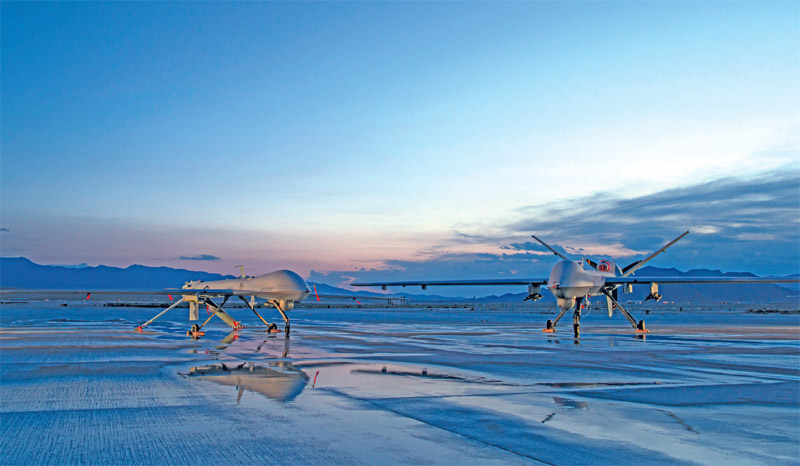
US Air Force’s MQ-1 Predator and MQ-9 Reaper. Pic courtesy Staff Sgt. Vernon Young Jr
Despite concerted efforts towards indigenous development, the nation has encountered setbacks due to fragmented coordination, technological gaps and regulatory ambiguities. The lack of a centralised nodal ministry for drone technology development has led to disjointed efforts across the civil and military sectors. While the United States, Europe and China have established clear frameworks for incubating UAV technologies and integrating them into the national airspace, India’s lack of policy articulation and cohesive direction has hindered its path toward self-reliance.
Former Indian Air Force (IAF) officer and current director of strategic initiatives in the Drone Federation of India, Gp Capt (Dr) R.K. Narang says the absence of a nodal agency for UAV regulation is a major obstacle in manufacturing advanced UAVs.
“China’s civil aviation authority is investing and creating an ecosystem to develop drone technologies and their integration in the national airspace. In India, we do not have a nodal ministry for drone technology,” he says.
Indigenous Projects
The early example of indigenous UAVs encountering challenges is the Nishant programmes. Launched by the Defence Research and Development Organization (DRDO) in the early 2000s, the programme aimed to create an autonomous reconnaissance drone. However, technical issues, including engine reliability and control system problems, plagued the programme. The Indian Army’s decision to crash limited units of the Nishant in 2011 because of operational difficulties highlighted the gap between ambitions and operational realities.
The struggle continued with the ambitious Tapas-BH201 project, also known as Rustom-II. Intended to be a cutting-edge surveillance and reconnaissance UAV, the project faced weight issues and over-engineering, delaying progress. Delays were exacerbated by slow sensor integration, hindering certification and evaluation trials. This experience showcased the intricate technical challenges involved in developing advanced UAVs. The maiden flight of Tapas-BH201 took place in November 2016.
Policy hurdles have also hindered indigenous UAV projects. The Tapas-BH201 faced delays because of clearance issues from government agencies such as the Directorate General of Civil Aviation (DGCA) and the Ministry of Defence. This bureaucratic red tape underscored the need for streamlined regulatory processes to expedite project timelines.
The Aura project, initiated to develop an autonomous unmanned combat vehicle with high-speed reconnaissance capabilities, faced technological hurdles. The project’s vision of incorporating a dry version of the Kaveri engine and advanced stealth properties posed significant challenges. The slow progress highlighted the stark reality of transitioning from ambitious goals to the painstaking groundwork required for advanced UAVs.






 VIDEO
VIDEO