

A Meeting of Interests
India-Bhutan relations have steadily moved from dependence to domain of interdependence. This firmly established newer relations matrix is rooted in four traditional matrices of sharing of natural resources, common cultural heritage, pilgrimage and connectivity linkages. Another four non-traditional variables are collective security platform, liberal economic assistance, newer trade contents and institution building.
These matrices have strong inbuilt elements of confidence and trust, remarkable trajectory of consistency and accommodation; deeper appreciation of sovereignty and identity and proven sensitivity related to clarity in future direction. The consultative and institutional mechanism, informal recognition of each other’s diverse national interest and acceptance of Bhutanese reassertion on certain national domain by India (like ‘no go’ signal to implementation of BBIN Motor Vehicles Agreement of 2015 by the ‘Tshogdu’ Bhutanese National Assembly) have facilitated this gradual entry into interdependence domain. It is largely because of these matrices of interdependence that Bhutan stood by India and vice versa in most trying and complex bilateral, regional and global circumstances. The most recent example is that of the deft and peaceful handling of the Doklam crisis in 2017.
The India-Bhutan Treaty of Perpetual Peace and Friendship of 1949 has been the corner stone of relationship in the post-Independence period. This Treaty stipulated that India would have a role in guiding Bhutan’s foreign policy. Article II of this Treaty stated that ‘The Government of India undertakes to exercise no interference in the internal administration of Bhutan. On its part, the Government of Bhutan agrees to be guided by the advice of the Government of India in its external relations.’
Significant amendments have been made to the 1949 Treaty which was replaced by a new Indian-Bhutan Friendship Treaty signed in 2007. Article 2 of this new Treaty states that ‘in keeping with the abiding ties of close friendship and cooperation between Bhutan and India, the Government of the Kingdom of Bhutan and the Government of the Republic of India shall cooperate closely with each other on issues relating to their national interests. Neither Government shall allow the use of its territory for activities harmful to the national security and interest of the other.’
Similarly, key provisions on free trade and commerce (Article 3) and arms imports ‘as may be required or desired for the strength and welfare of Bhutan’ (Article 4); as well as guarantees that ‘Bhutanese subjects residing in Indian territories shall have equal justice with Indian subjects, and that Indian subjects residing in Bhutan shall have equal justice with the subjects of the Government of Bhutan.’ (Article 5) have been kept intact. Bhutan acts as a buffer state between India and China wherein Bhutan has border of 699km with India, and 470km with China. Bhutan and China continue to have border disputes, as documented in the Bhutan-China agreement of 1998.
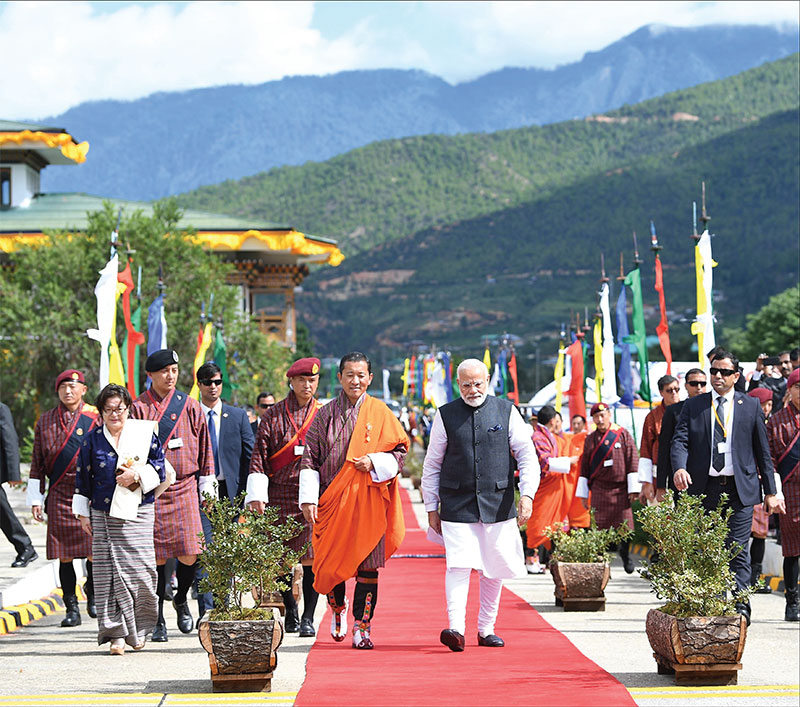
Prime Minister Lotay Tshering with Prime Minister Narendra Modi during the latter’s August 2019 visit
Evolving Democracy
Bhutan is an evolving democracy. The third national assembly election held in 2018 since it adopted a democratic constitution in 2008 once again brought a new party to the Himalayan Kingdom. The Druk Nyamrup Tshogpa (DNT) led by a medical surgeon and present Prime Minister Lotay Tshering won 30 out of the total 47 National Assembly seats. The Druk Phuensum Tshogpa which had won 45 out of 47 seats in the first national assembly election in 2008 was wiped out in 2013 election. It now got resurrected with 17 seats to be the only opposition party. As per the Bhutanese constitution only two top winning parties that won the primary election can contest the final election. In the process, the incumbent party People’s Democratic Party stood a poor third in the September 2018 primary election and withdrew from the election process. The DNT, a ‘people-centred and pragmatic party’ governed by the principles of social democracy was initiated in 2013 and rose to sweep the entire crucial south, south west and western Bhutan seats in 2018 election.
Bhutanese elections are fought on largely development issues. Despite the Doklam imbroglio involving India and China in 2017, wherein the Bhutanese national identity and sovereignty was the core issue, political parties are literally silent on issues of foreign policy and national security. This unique feature has been the quintessence in their election manifestoes. DNT made simple yet touching; and imaginative all encompassing election promises. These were addressed to a yak herder in mountainous Haa and inspired a young entrepreneur in a plains land border town of Phuntsholing.
For instance, it promised access to specialist services like endoscopy, ultrasound and blood test at gewog levels; additional generation of 5,200MW of hydropower, establish employment and livelihood corporation; procure farm produce from farmers at a price announced a year ahead; narrow the digital divide, establish free Wi-Fi access points; review Class X cut-off point to enable financially challenged students to continue until Class XII; build a southern east-west highway; provide six-month maternity leave and free sanitary pad to all girl-students in schools. The size of constituency and the very character of the Gross National Happiness (GNH) oriented society make elected representatives increasingly accountable.
Bhutan has come a long way from a nation strongly based on a politico-religious ethos TSA-WA-SUM (the country, the people and the King) where the Monarchy continues to remain the most decisive and core actor in both the domestic and foreign affairs. In the whole of 1990s, the country was embroiled in a global embarrassment triggered by refugee exodus mostly Nepali-speaking Lhotsampas from the southern Bhutan. For almost two decades, they lived in several refugees camps in Eastern Nepal. Most of them have now been provided the third country settlement including in US, Europe and Canada. India maintained absolute neutrality in the protracted bilateral negotiation between Nepal and Bhutan. However, the inclusion of and victory of Nepali speaking Bhutanese from southern Bhutanese districts like Tsirang, Samtse, Sarpang and Phuentosoling town does indicate the remarkable reconciliation process set in by both the Monarchy and democratic process.
Hydro Diplomacy
India-Bhutan cooperation in developing hydel power projects is a successful model. Installed hydropower capacity of 1,615MW in Bhutan constitutes less than six per cent of total potential of 30,000MW. Considered as the backbone and instrument to achieve self-sufficiency, most of these projects have been built with Indian support initially on an economic assistance basis which now has much higher loan content.
Subscribe To Force
Fuel Fearless Journalism with Your Yearly Subscription
SUBSCRIBE NOW
We don’t tell you how to do your job…
But we put the environment in which you do your job in perspective, so that when you step out you do so with the complete picture.
 VIDEO
VIDEO