

A Journey of 74 Years
There are two distinct and opposing re-balancing exercises currently underway within the armies of India and China along the Line of Actual Control (LAC). While the former is focussing on the raising theatre-specific Integrated Battle Groups for HQ Northern Command, the latter is introducing a hierarchical ‘Synthetic Division-Synthetic Regiment-Synthetic Battalion’ for Peoples’ Liberation Army Ground Forces’ (PLAGF) South Xinjiang Military District (SXMD). Both processes aim at acquiring the required capacities and capabilities for waging limited high-altitude mountain warfare and high-altitude plateau warfare. Since realistic competitive benchmarking of these two processes will be premature at this stage, an examination of their evolutionary processes over the past 34 years can serve as a useful indicator of the two respective desired end-states.
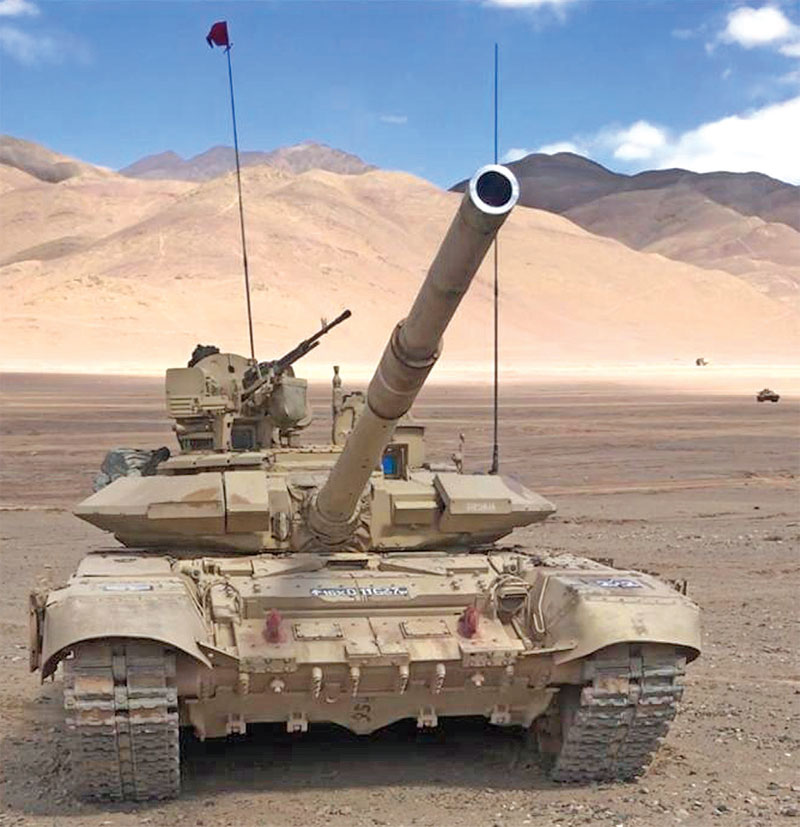
Indian Army’s T-90S Main Battle Tank in Ladakh
The Pioneers
India’s armed forces, that have since October 1947 frequently been tasked to achieve the impossible, have never failed to deliver, often going way above and beyond the call of duty by using the genius of institutional improvisation. It is due to this that the Indian Army (IA), ably supported by the Indian Air Force (IAF) enjoys the enviable and as-yet unmatched reputation of being the world’s only army to deploy and successfully employ armoured vehicles at forbidding altitudes, from 12,000 feet to 16,000 feet above sea level.
The first such chance came in late 1948, when under Operation Bison the IA used its M-5 Stuart light tanks of 7 Cavalry Regiment to dislodge Pakistani tribal invaders from Zoji La in northern Jammu & Kashmir and then head towards Dras and Kargil. Until then, nowhere in the world had tanks operated at such heights. Within a month, the IA’s Madras Sappers had built a track that the M-5 Stuarts could use to reach Zoji la from Baltal. The plan also involved the move of a Stuart squadron located at Akhnoor across the Pir Panjal Range. After negotiating the tough terrain, which was steep and slippery amid heavy snowfall, the Stuarts reached the Ghumri basin on 1 November 1948, at 1440 hours. From then on, the IA pushed further and captured Matyan, 18km ahead of Zoji La, on November 4. By November 16, Dras, the second-coldest inhabited place in the world, was captured. The brigade resumed its advance on November 17-18 with Kargil as its main objective. By November 25, all enemy positions on the way to Kargil were eliminated and the direct link from Leh to Srinagar restored.
During the India-China war in 1962, two troops of AMX-13 light tanks were air-lifted by the IAF by October 26. They played a decisive role in deterring the PLAGF from capturing Chushul after advancing through the Spanggur Gap. However, it was in mid-1986 that the Chief of the Army Staff (COAS) Gen. Krishnaswamy Sundarji ordered the IA to ‘go to Ladakh and make history!’ as part of the riposte in the midst of Operation Falcon that had then commenced in Arunachal Pradesh (the Wangdung incident along the Sumdorong Chu).
While the IAF had practiced carriage of main battle tanks (MBT) in the plains, landing at the Leh airport—located at 10,300 feet and surrounded by high hills—presented technical difficulties. Expectedly, the IAF rose to the occasion. In the last quarter of 1986, the IA, under Operation Kartoos, had six T-72M MBTs airlifted to Leh (by IAF’s IL-76MD transports) along with 20 BMP-1 infantry combat vehicles (ICV) for deployment in Chushul, the Fingers Area of Pangong Tso as well as the Spanggur Gap. Following them were 22 more BMP-1s, 10 15-tonne BMP-2 ICVs (with power-to-weight ratio of 21hp/tonne), three armoured recovery vehicles (ARV) and two armoured squadrons comprising 14 37-tonne T-72Ms and two ARVs.
The Regiment (less one Company) temporarily settled down at Karu, 40km from Leh. One Company was located 120km to the east at Tangtse for deployment in the Chushul sector, which was another 100km to the east. The move of this Company by road across the 17,500 feet high Chang La was a great confidence builder. The BMP-1/2 were unique ICVs that could maintain the same average speed as heavy wheeled vehicles. Within a week, the Regiment selected the new administrative base for the in-theatre mechanised forces at Stakna, close to Karu.
Subscribe To Force
Fuel Fearless Journalism with Your Yearly Subscription
SUBSCRIBE NOW
We don’t tell you how to do your job…
But we put the environment in which you do your job in perspective, so that when you step out you do so with the complete picture.






 VIDEO
VIDEO