

A Global Collective
That the topic chosen for the first ever UNSC meeting chaired by an Indian Prime Minister under the agenda item ‘Maintenance of International Peace and Security’ was ‘Enhancing Maritime Security: A Case for International Cooperation’, clearly indicates the importance this topic holds for the world’s peace and security.
The ‘high-level participation from many countries, substantive discussions and adoption by consensus of the first ever outcome document on the topic’ was further proof of the importance of the topic. Maritime security can be endangered by a wide variety of entities, with refusal of countries to obey international law, maritime terrorism, hijacking, piracy, illegal trafficking of humans, narcotics, weapons, explosives, illegal fishing, illegal mining, armed robbery, smuggling, environmental disasters, and climate change being salient.
As the oceans connect this world like nothing else, events in one place could affect even places far away. The extensive linkages and inter dependencies of today’s globalised world can lead to isolated incidents affecting the economic wellbeing of several countries or the peaceful lives of large numbers of people spread across a wide region. The global nature of the fallouts of events makes their methods for mitigation too equally global.
Consequently, critical imperatives for maritime security and safety are numerous. Therefore, I will deal with only a few issues that are critical for India, viz, the progress we have made towards maritime security and its subset coastal security, our efforts at gaining maritime domain awareness (MDA) and possibilities for international cooperation.
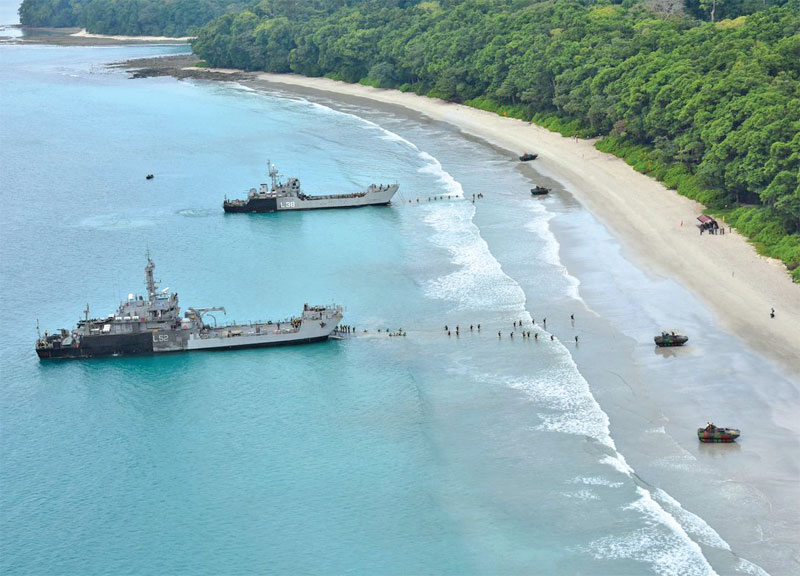
Exercise DANX being held in 2017 at the Andaman & Nicobar Islands
India’s Inexplicable Sea Blindness
For a country with a coastline exceeding 7,500 km, an Exclusive Economic Zone (EEZ) of 2.03 million sqkm and almost 1,400 islands, India’s sea blindness is astounding. That the colonial powers who exploited India for 450 years had come and gone by the sea and that they had transported their loot by the sea appear to have scarred India’s consciousness. Even today, with over 90 per cent of our trade by volume and over 70 per cent by value being seaborne, India embraces the oceans with reluctance.
Policy makers understand little of the sea and maritime affairs hardly figure in the general narrative. The extent of our land-centric thinking defies logic. But there is hope. Heavily maritime oriented themes like SAGAR, Sagarmala, Blue Economy, Look/ Act East are emanating from the highest levels. But much more transformation is needed at the lower levels for such vision to translate into action on ground. With events on our land borders getting ever more difficult, calls for India to ‘forget Afghanistan, Pakistan etc and shift strategic gaze to the seas’ are beginning to appear in public discourse. After pressing home the view that ‘the current century and possibly the next one too, are very likely to be maritime-centric ones’, the DG National Maritime Foundation—probably packaging a fond wish as a possible governmental policy position—avers that ‘India’s polity appears to be finally coming around to the fact that over the foreseeable future, India will be either be a ‘maritime’ power, or it will not be a power at all’. Bold words those. However, he has a point. India, like several entities in the Indian Ocean region, is at crossroads, and one way for a safe and secure future is to increase the centrality of our oceans to our policymaking. And at the core of this lies the ability to protect India’s maritime interests. Not an easy task.
A Timeless Paradigm
The immense potential for national prosperity and wellbeing offered by India’s location and geography cannot be realised without mitigating the equally immense vulnerabilities, also presented by the same location and geography. What a paradox. Even a cursory look at the six principal conditions that AT Mahan considered as what affects a nation’s sea power, viz, geographical position, physical conformation, extent of territory, size of the population, character of the people, and character of the government, reveal what India can be, and how it can be what it can be if it wants to be what it can be. India also particularly fits in as a perfect example for Mahan’s formulation of ‘Physical Conformation’, which he elaborates thus. ‘The seaboard of a country is a frontier. Easier the access to it, greater is the interaction with the world. Deep harbours are a source of strength and wealth, and navigable streams help concentrate the country’s internal trade at these harbours.’ It is exactly these attributes that kept colonial powers in our land, causing us immense harm. There is a danger that this Mahanian exposition of the ‘seaboard’ being a ‘frontier’ is misunderstood as the ‘coastline’ being a ‘border’. Nothing can be more wrong. Security of the coast is not security of the maritime space. They are different.
Subscribe To Force
Fuel Fearless Journalism with Your Yearly Subscription
SUBSCRIBE NOW
We don’t tell you how to do your job…
But we put the environment in which you do your job in perspective, so that when you step out you do so with the complete picture.






 VIDEO
VIDEO