When India signed a deal worth USD3 billion with the US State Department to buy 31 armed MQ-9B SkyGuardian and SeaGuardian High Altitude Long Endurance (HALE) drones last year, the country was basically making a major transition in warfare, one that is touted as the most significant, revolutionary and disruptive development since World War II. The 31 drones will be allocated as follows—15 for the Indian Navy and eight each for the Indian Army and Indian Air Force.
India will primarily use drones for intelligence, surveillance and reconnaissance. The leased SeaGuardians have helped the Indian Navy monitor over 14 million square miles in the Indian Ocean. Interestingly, these are the same drones that the US had refused to sell years back to its Nato ally Turkey for its counterinsurgency operations against the Kurdish militants in its south. That rebuff led Turkey to embark upon its own programme and come up with a sure-fire winner, the Bayraktar TB2, which has proved to be highly effective in intelligence gathering, surveillance, and targeted strikes against various insurgent groups within and outside of Turkey.
Drones are revolutionary in the way artillery or tanks were once a game changer. Though drones have been in use for over two decades by the US in its Global War on Terrorism (GWOT), the first widespread use of unmanned aircraft in general, its coming of age in classical combat, was demonstrated in the conflict between Armenia and Azerbaijan. In this conflict small tactical drones effectively provided intelligence, surveillance, and reconnaissance support for Azerbaijan ground manoeuvres. This added battlefield situational awareness and contributed to the eventual defeat and withdrawal of Armenian forces from the contested Nagorno-Karabakh region.
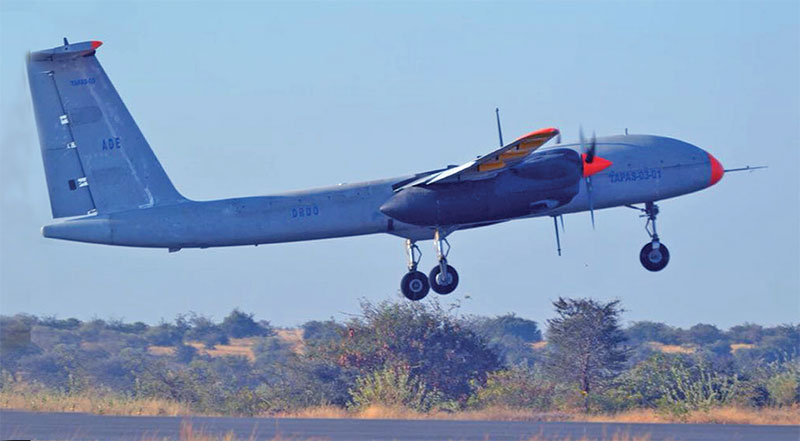
DRDO’s Rustom-1
In the ongoing conflicts in Ukraine and West Asia, drones have been the most used offensive weapon systems, overwhelming the best and most sophisticated air defences and imposing prohibitive costs on the defender. Ukrainians and Russians have both employed drones successfully to limit freedom of movement, provide intelligence, and conduct direct strike attacks. The tiny, inexpensive first-person view (FPV) drone has proved to be one of the most potent weapons in this war, where conventional warplanes are relatively rare because of a dense concentration of anti-aircraft systems near front lines. FPVs, originally designed for civilian racers, are controlled by pilots on the ground and often crashed into targets, laden with explosives.
In the West Asian theatre, Israel has faced barrages of drones over the past year from the Hamas, Hezbollah, the Houthis and from Iran, overwhelming its fabled air defences and imposing heavy costs. In the Red Sea, the US Navy destroyers have shot down 38 drones and multiple missiles but what worries Pentagon is the cost of using expensive naval missiles which can run up to USD2.1 million a shot to destroy unsophisticated Houthi drones estimated at USD2,000 each.








 VIDEO
VIDEO