The Quadrilateral Security Dialogue, or the Quad, is an informal strategic forum which includes the US, India, Japan and Australia. It was first established as a joint response to the devastating Boxing Day tsunami in the Indian Ocean in 2004. The grouping then met in 2007. The Quad was supposed to establish an ‘Asian Arc of Democracy’ but was hampered by a lack of cohesion among its members. It broke apart for several years before coming together again in 2017 given the convergence of security interests in the Indo-Pacific in the light of China’s rise.
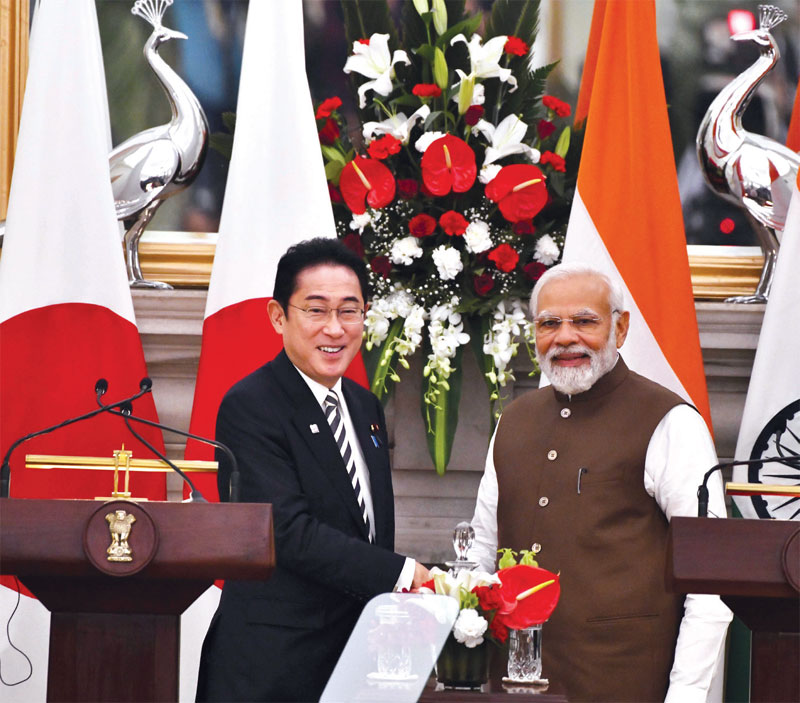
Japanese Prime Minister Fumio Kishida with Indian Prime Minister Narendra Modi
China was quick to call it an anti-China bloc and ‘Asian Nato’. The Quad held its first formal meeting in 2021 and the grouping has maintained that its purpose is to deepen economic, diplomatic and military ties among the participating members. Most recently, ahead of the G20, the foreign ministers of these countries met in Delhi.
In a joint statement, the grouping said, ‘Our meeting today reaffirms the Quad's steadfast commitment to supporting a free and open Indo-Pacific, which is inclusive and resilient.’ The Quad called for ‘the importance of adherence to international law’ in the East and South China Seas ‘to meet challenges to the maritime rules-based order.’ It added, ‘We express serious concern at the militarisation of disputed features, the dangerous use of coast guard vessels and maritime militia and efforts to disrupt other countries’ offshore resource exploitation activities.’
The grouping regularly holds military exercises—Malabar. The 26th edition of this exercise took place in November 2022 in the seas near Yokosuka in Japan. The exercise aimed at cooperation in the strategically significant Indo-Pacific region was hosted by the Japan Maritime Self Defence Force (JMSDF). The sea phase of Malabar-22 was conducted over a period of five days near Yokosuka and witnessed live weapon firings, surface, anti-air and anti-submarine warfare drills and tactical procedures. At the sea phase, the navies conducted the ‘War at Sea’ exercise, which enabled all four navies to consolidate interoperability and hone their tactical skills.
The high-tempo exercise saw the participation of 11 surface ships, including a nuclear-powered aircraft carrier with its integral air elements, along with four long-range maritime patrol aircraft, integral helicopters and two submarines. The exercise also involved exchange of ‘Sea Riders’ between various participating ships. Apart from operational drills and exercises, the bilateral logistics support agreements between the participating countries were validated during this edition of exercise Malabar. The Indian Navy was represented by the Eastern Fleet, which sent its stealth multirole frigate INS Shivalik and anti-submarine corvette INS Kamorta.
The 25th edition was hosted by the US Navy in the Western Pacific.
The Malabar series of exercises began in 1992, with a maritime drill between the navies of India and the US. In 2015, the JMSDF joined Exercise Malabar as a permanent member. The 2020 edition witnessed the participation of the Royal Australian Navy.








 VIDEO
VIDEO