

2019 At a Glance | A Year Like No Other
On February 14, Adil Ahmad Dar, a Kashmiri militant, rammed his explosive-laden vehicle into a Central Reserve Police Force (CRPF) bus, killing 40 personnel. The bus was part of a convoy of 78 buses carrying the paramilitary police on the Srinagar-Jammu highway in Pulwama district of Jammu and Kashmir. The devastating attack shocked rest of India and the world.
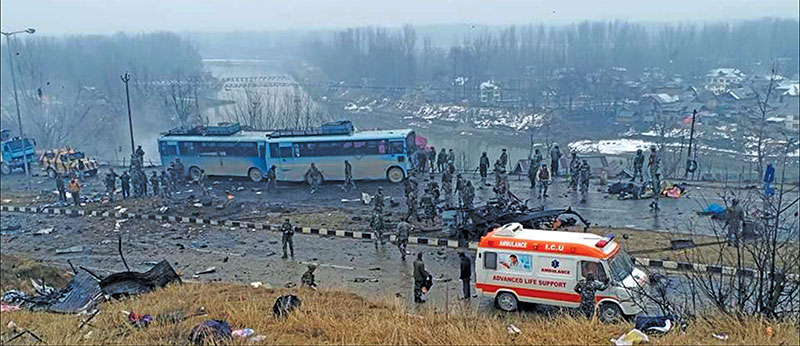
The site of Pulwama bombing in Kashmir
Soon after, Pakistan-based militant group, Jaish-e-Mohammad (JeM) claimed responsibility for the attack even though Pakistan denied any involvement in the attack. This led to tension between the two countries. Eventually all trade ties were severed. In the meantime, the Indian Army initiated a massive crackdown on JeM, and within a few months, killed most of its leaders.
The government faced severe criticism over the loopholes that led to the attack. It came under fire for lack of security along the 300-km long Jammu-Srinagar highway. The outrage prompted the government to take immediate steps to address the gaps, including among others air travel to the valley for CRPF personnel.
The most decisive action taken by the government post Pulwama attack was air strike on the Jaish-e-Mohammed training camp on Jaba hilltop in the Balakot district of Khyber-Pakhtunwa, Pakistan on February 26. The Indian Air Force (IAF) fighter jets crossed the Line of Control (LC) and bombed targets deep inside Pakistan territory. The IAF Mirage-2000 fighter jets took off from different airbases in India before dawn and targeted the JeM training camps with precision guided missiles. Pakistan Air Force retaliated the next day. PAF fighters crossed the LC in the Jammu sector and dropped bombs on non-military targets to ‘demonstrate our right, will and capability for self-defence’.
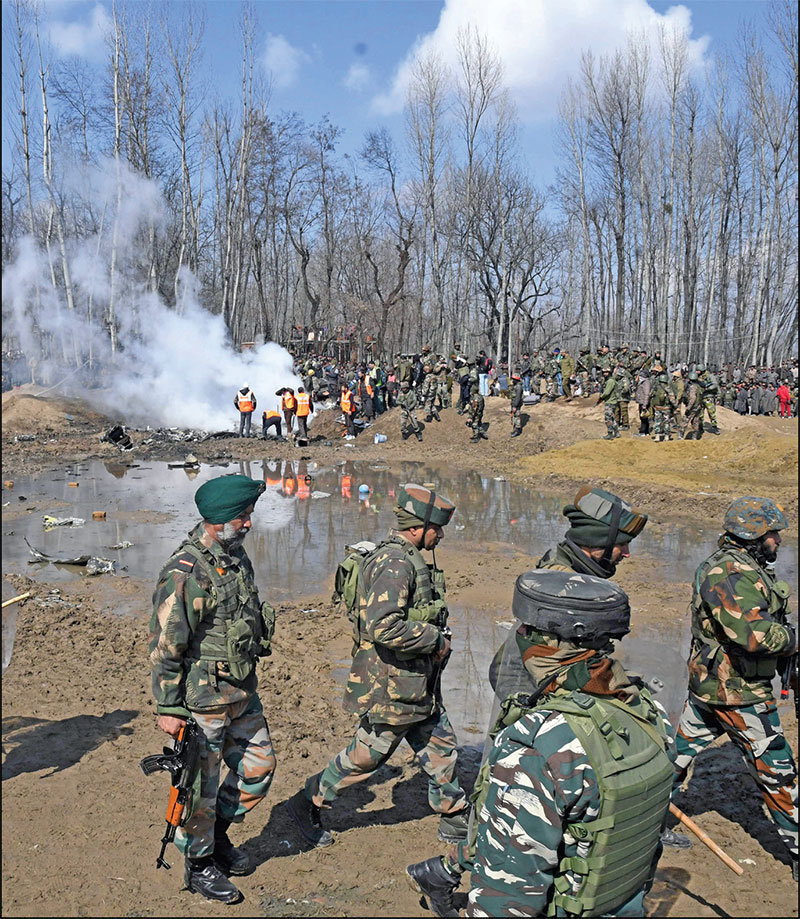
The IAF scrambled Su-30MKIs and MiG-21s to take on the PAF fighters. In the ensuing dogfight, IAF fighter pilot Wing Commander Abhinandan Varthaman chased the PAF JF-17 into POK where his fighter was shot. Wing Commander Abhinandan had to bail out and was taken into custody by the Pakistan Army.
A war of claims and counter-claims followed. In the midst of all this, the IAF’s Mi-17V5 helicopter crashed in the Budgam district of Jammu and Kashmir on February 27. Initially assumed to be a handiwork of Pakistan or technical error, the subsequent IAF enquiry revealed that the helicopter was hit by an IAF missile in the case of fratricide because of the fog of war. Two officers — the chief operations officer (COO) and the senior air traffic control officer (SATCO) — were charged with negligence. The crash resulted in the death of seven IAF personnel.
The tensions between the two nations eased slightly after Pakistan agreed to release IAF fighter pilot Wing Commander Abhinandan on 1 March 2019.
Two days after the Pulwama attack, on February 16, 137 aircraft from the IAF carried out a massive exercise along the border, striking ground targets 200 kilometres south off Bahawalpur, the headquarters of the JeM. Although the large-scale exercise Vayu Shakti was pre-planned, it raised eyebrows with its timing and the massive scale. The IAF carries out exercise Vayu Shakti once every three years to demonstrate and test its war-preparedness. This time, however, it became a topic of discussion amongst the military strategists and the public on both sides of the border.
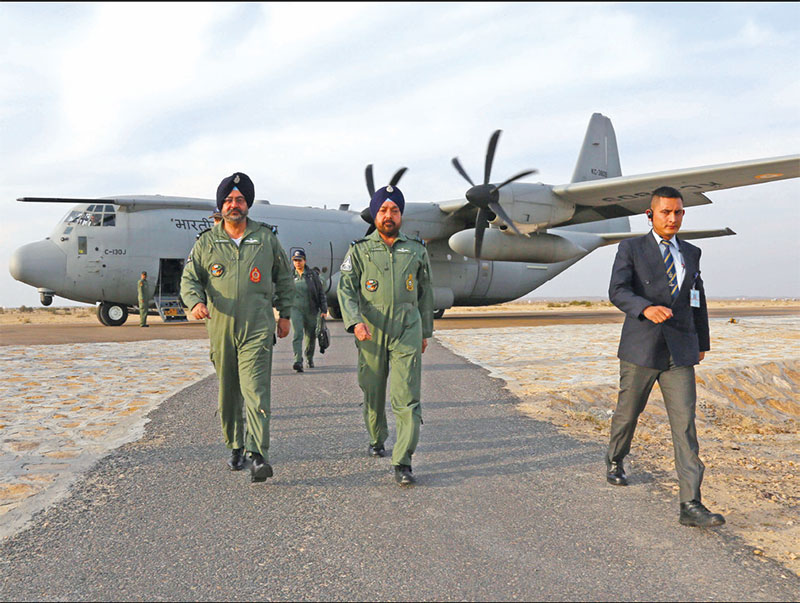
In another major exercise Gagan Shakti, conducted in 2018, the IAF had demonstrated its air-to-air combat capabilities, engaging a large number of aircraft. However, exercise Vayu Shakti 2019 was mainly about displaying the air force’s ability to strike targets on the ground. The then Air Chief Marshal Birender Singh Dhanoa arrived in a C-130J aircraft, landing in front of the spectators on an 800m-long makeshift airstrip. C-130J, built to release commandos into enemy territory, is an indispensable asset, having proved its mettle over the years.
MiG-29UPG showcased its new ground-strike capability in an air-to-air combat drill for the first time after it was promoted for this role. Akash missile firings were on a large scale, along with gun firing from MiG-29 and ALH. The firepower demonstration was used to showcase the capabilities of frontline fighter aircraft such as the Sukhois, Mirage-2000, MiG-29, Jaguar and others. The exercise, held on a massive scale, involved combat helicopters, fighters, transport aircraft, force enablers and support systems.
Subscribe To Force
Fuel Fearless Journalism with Your Yearly Subscription
SUBSCRIBE NOW
We don’t tell you how to do your job…
But we put the environment in which you do your job in perspective, so that when you step out you do so with the complete picture.






 VIDEO
VIDEO