

More Talk, Less Make
Accountability is the keyword to speed up indigenous defence production
 Gp Capt. A.K. Sachdev (retd)
According to the 2026 Global Air Power Rankings published by World Directory of Modern Military Aircraft (WDMMA), the Indian Air Force (IAF) is at the sixth position, just ahead of China’s Peoples’ Liberation Army Air Force (PLAAF). Pakistan stands at 18th rung.
While that tidbit is something to revel in, the delight it offers is tempered by concerns summarised in the theses listed here: government pushes (and shoves)—with all good intent—have supported ‘Make in India’ since 2014, and its latter avatar aatmanirbharta since 2020; in pursuit thereof, the public sector has not been able to assimilate and learn to the same level as China has, and its inherent inefficiencies have not produced globally competitive products in many sectors, including aerospace; private industry has been permitted a (near) level playing field in that domain only in recent years; the IAF is currently down to 29 (or 30) combat squadrons against a sanctioned strength of 42, and its needs and wants are in urgent need of being quenched. This article examines how ‘Make in India/ Aatmanirbharta’ are serving the IAF and how they are likely to sustain it in the near future.
India’s Self Reliance Ambitions
Defence production in India touched Rs 1.78 lakh crores during the last financial year which is almost a sixth more than the last year’s figure. The government points out that this is four times the figure of 2013-14 (prior to BJP coming to power) and has set for itself a target of Rs 8.8 lakh crores by the year 2047, a six-fold increase from the current level. This laudable prognostication encompasses R&D, design, production and export of leading edge weapon systems, including in the technology dominant arena of aerospace industry.
Another cheering statistic is that defence exports reached a high of Rs 38,424 crore during the last financial year, a figure representing a 62.66 per cent jump from the previous financial year. The increase signifies growing global demand for Indian-made military equipment and technologies. The public sector accounted for a little more than half of the exports.
A little less cheer emerges from a June 2026 PwC report entitled ‘Accelerating aerospace and defence manufacturing through operational excellence and supply chain resilience’. The report is optimistic about strong demand and acknowledges steady rise in exports but is glum on the subject of execution at scale as the order backlog trails up to a decade in some cases. The backlog-led growth is in need of enhanced performance, something that has niggled industry’s failure to meet IAF’s urgent and critical needs, especially of combat aircraft.
Combat Aircraft
Combat aircraft are the teeth of an air force; a current holding of three-quarters of its sanctioned strength renders to the IAF a great handicap. So why has this sorry state come to pass? The first ‘indigenous’ combat aircraft was the HF 24 Marut as far back as the Sixties (with a still-borne HF 73 that tragically died on the drawing board!) but the momentum was lost thereafter for two decades until the Light Combat Aircraft (LCA) programme, or Tejas, was initiated in the Eighties. Forty Tejas Mk1s were ordered and the first one entered service in 2016. Thirty eight are in service currently but they are not combat aircraft and serve more as a testbed for the improved Tejas Mk1A which will have weapons capability.
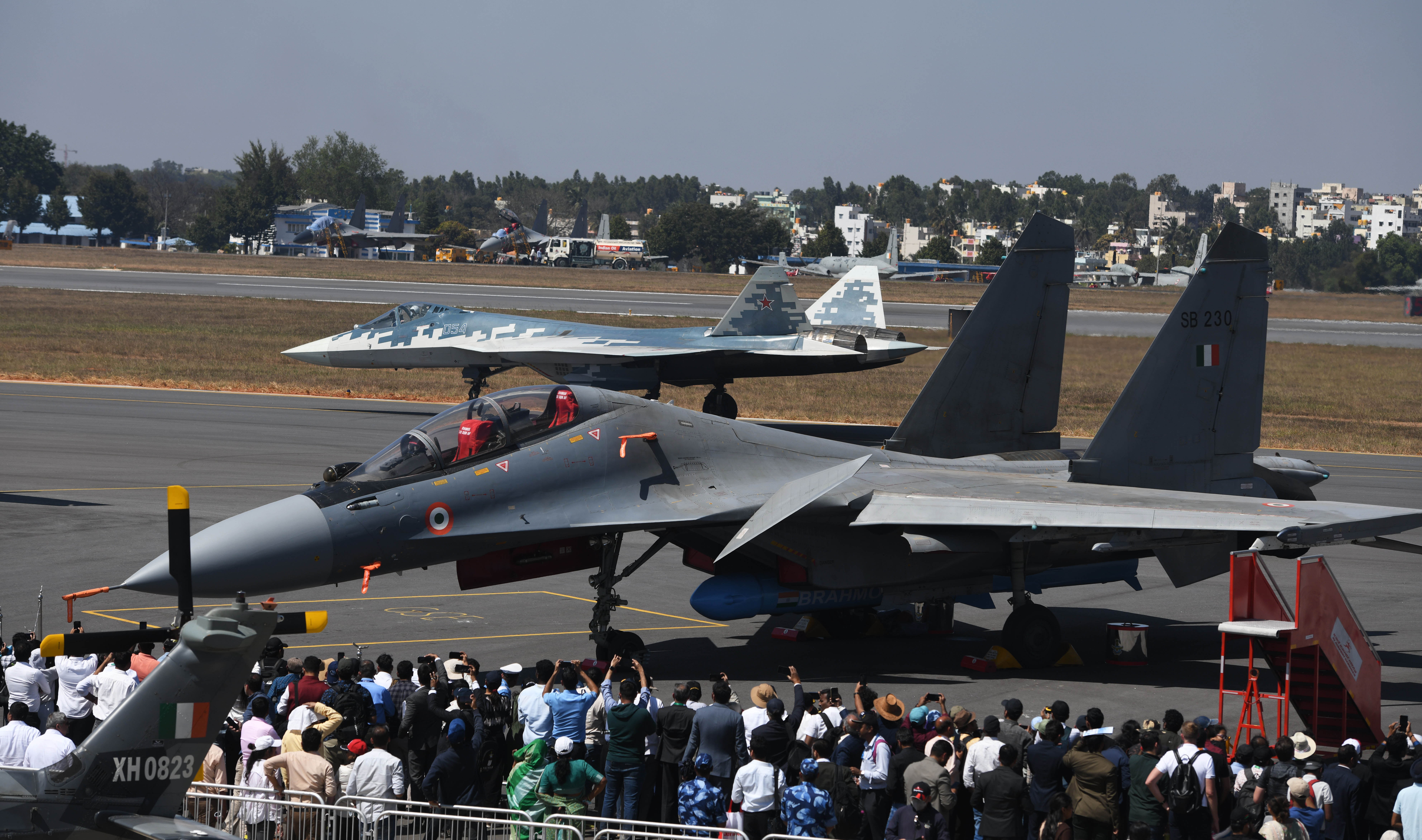
However, the Mk1A is far behind schedule. With 180 of these untested, yet to be inducted aircraft on order, the IAF is understandably getting fidgety. Over the last decade successive chiefs of air staff (CAS) have publicly expressed their displeasure over the delays in Mk1A delivery to the IAF. The Tejas programme was intended to replace the ageing fleet of MiG 21s which has retired in toto but the first delivery of the Mk1A is yet to take place. While Hindustan Aeronautics Limited (HAL) has the convenient alibi of delay in receipt of the aero engines for the Mk1A, that is not the only reason for the inordinately delayed Mk1A deliveries. The engine story is also a sordid saga and is covered later in this article.
It may be mentioned that even if the GE engines had been supplied on time, the Mk1A could not have been ready on time as the integration of the EASA radar and Electronic Warfare (EW) suite, et al is still ‘work in progress’. The aircraft is not expected to be ready soon despite the availability of adequate engines from GE. Any first flight dates for the fully integrated Mk1A are to be taken with a pinch of salt.
In short, India is yet to produce its first ‘Make in India/ Atmanirbhar’ combat aircraft. Forty three years after the LCA programme was officially initiated by India, the first combat ready Tejas Mk1A is yet to be offered to the IAF. The IAF has 180 of these on order (83 ordered in 2021 and another 97 ordered in 2025) and at a high-level meeting in June this year, HAL was formally warned by the ministry of defence (MoD) about penalty clauses; the next meeting on the subject is expected to take place in September this year and to be chaired by the defence ministry. However, a relevant misgiving about placing an order for 180 unproven and unready aircraft points to a questionable haste in flaunting the aatmanirbhar banner. A spin off of this order is that the pressure is off HAL, now smug with a confirmed order under its belt.
This inordinate delay should be viewed against the background of HAL’s experience of licensed production and assembly of aircraft of Soviet and European designs such as the Gnat, MiG 21 (a large number of variants), Jaguar, Hawk and Su 30MKI besides the HF 24 already mentioned. That HAL squandered decades of opportunity to learn (or reverse engineer like the Chinese) is reflective of India’s failure to cultivate its aatmanirbharta in aerospace industry.
An even more ambitious programme than the Tejas Mk1A is the Tejas Mk 2, which remains a nebulous object of desire whose first flight is still a distant dream (never mind ever refreshed dates of first flight announced by HAL). Incidentally, although sharing the name Tejas with the LCA, the Mk2 is expected to be a Medium Weight Fighter (MWF) with an increased Maximum Take Off Weight (MTOW) of 17.5 tons compared to Mk1A’s 13.5 tons, a more powerful engine (although still a General Electric (GE) engine as the future of India’s aeroengine is uncertain), and a larger payload of 6.5 tons compared to a little over 4 tons for Mk1/Mk1A. The IAF has committed to acquiring six squadrons of Tejas Mk2 and has said that it will decide on further numbers once production commences. However, at the time of writing this, Mk2’s future is uncertain.
Further up the aatmanirbharta ambition ladder is India’s 25-ton, twin-engine, 5th generation stealth fighter programme Advanced Medium Combat Aircraft (AMCA). The programme is projected to be a public-private partnership model with an emphasis on aatmanirbharta based on indigenous manufacturing endeavours. The vision is to engage sizeable private sector enterprises like Tata Group, Larsen & Toubro, Kalyani Group, Adani amongst others in competitive bids so that indigenous aerospace industry is fostered and costs are kept low. Prototype development has already started but the programme is managed by Aeronautical Development Agency (ADA) and some of the manufacturing content may be bagged by HAL—both public sector enterprises with uninspiring work cultures. Thus, despite all the clamour about aatmanirbharta, India is constrained to seek combat aircraft from foreign original equipment manufacturers (OEMs) as few deadlines announced by ADA and HAL in the past have been adhered to.
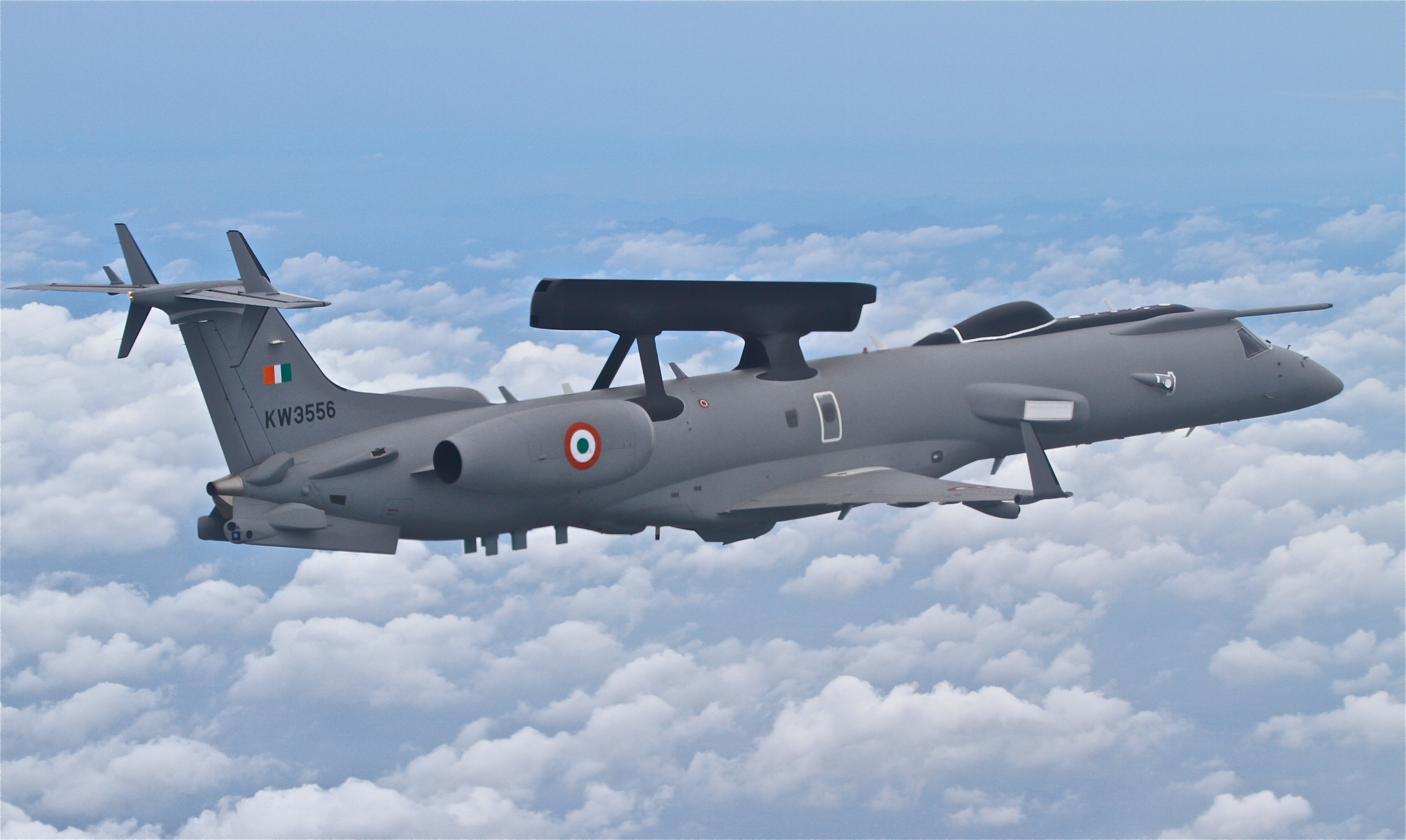
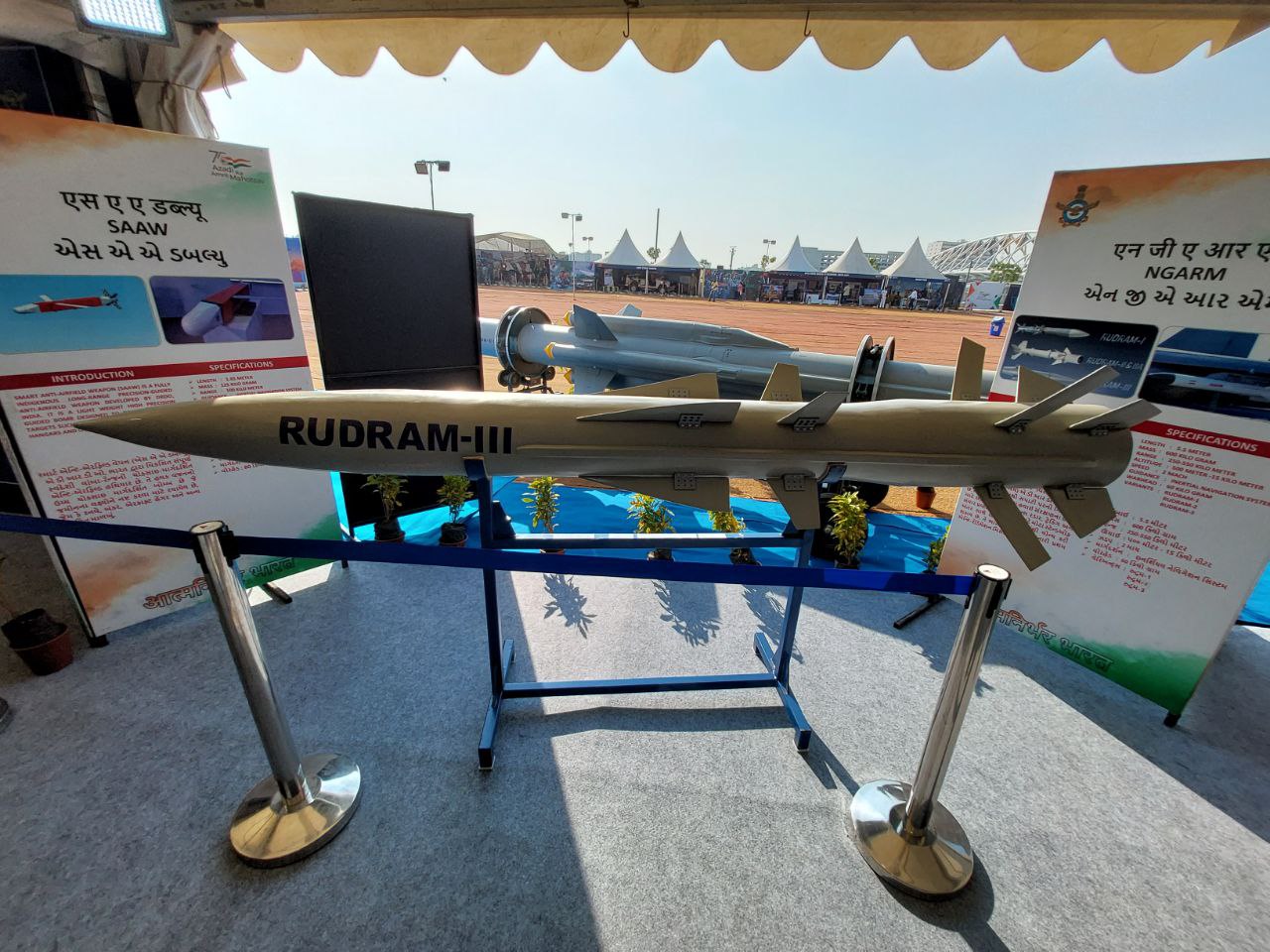
clockwise from top left 20-Rafale jet and jaguar aircraft-1; AEW&C; Full size AMCA model with its weapons 1; Rudram-3 ARM; Tapas MALE-UAV
Foreign Fighters and Aatmanirbharta
During the Nineties, anticipating serious shortfalls, IAF proposed going in for more Mirage 2000 aircraft to be produced under license by HAL in India to cater to the anticipated shortfall. The IAF diligently carried out all the staff work necessary, but the Defence Acquisition Council (DAC) scrapped the whole idea in 2003. In its place, a Request for Information (RFI) was floated in 2004 for purchase of 126 Medium Multi-Role Combat Aircraft (MMRCA) with 4½th generation capabilities, with the first induction planned for 2010. The IAF shortlisted the Rafale in 2012 but its manufacturer, Dassault, had reservations about quality and punctuality responsibilities if HAL was the Indian partner (Dassault favoured Reliance). So much for aatmanirbharta! However, in March 2014, HAL, using its strong lobby at the Centre, signed an agreement with Dassault for licensed production of the Rafale in India.
While the final details of that deal were being negotiated, in April 2015, Modi dropped a bombshell on the IAF by announcing during an official visit to France, that India would acquire 36 Rafales from France in a fly away condition. The 126 MMRCA deal was scrapped altogether and a Memorandum of Understanding (MoU) signed in 2016 for 36 Rafales which have since been received. However, this number was 90 short of the original figure of 126 and the shortfall had further increased during the decade-long wait for the MMRCA.
In April 2018, a fresh RFI was promulgated by MoD for the acquisition of 110 Multi Role Fighter Aircraft (MRFA) [the figure was later revised to 114]. The MRFA saga, yet to be consummated through a final deal, has been one of assertive iterations about aatmanirbhar content by India and, in response, not so lucrative incentives offered by contending OEMs from a position of strength. Dassault’s Rafale appears to be ahead in the race to secure the MRFA deal. The demise of MMRCA was partly due to Dassault resisting HAL’s lead role in the project, a mistake that is being remedied through HAL not being given the lead role for MRFA; Tata, Mahindra and Adani are being evaluated instead for the 92 fighters to be produced in India (the first 22 being provided by Dassault in a fly away condition.
Aeroengines, India’s Achilles Heal
The (fairly substantive) Rafale deal could have been used as a lever to extract the full aeroengine technology for its M88 power plant from Safran but that does not appear to be on the cards. Some components of the M88 engine may be produced in India if the Rafale is our final choice, and is being propagandised as a boost to aatmanirbharta, technology transfer and domestic aeroengine industry but the indications are that only up to 60 percent of the engine may be produced in India. It does not require a genius to surmise that the 60 percent would be a quantitative measure of localised production while key technologies would still be denied to Indian entities. One wonders if this arrangement is being accepted by India with a quid pro quo understanding with Safran that it will help India’s Gas Turbine Research Establishment (GTRE) produce an engine for the AMCA Mk2 (the Mk1 is planned to fly with GE F414 engines).
It is worth pondering over why China, which started on its quest for aeroengine technology almost at the same time India did, has forged ahead of India. Its 5th generation combat aircraft, the J20, is fitted with a completely indigenous aeroengine—the WS-15. An even more sobering thought is why India has not been able to achieve a similar reverse engineering subterfuge. The answer is not far to find. GTRE, our public sector aero engine research entity set up in 1959, has not been able to meet the country’s combat aircraft aero engine demands so far despite enormous investment by the government in real estate (around 90 acres in prime locale), a generous budget, sprawling infrastructure, and manpower as demanded. It has indeed had some successes but the aeroengine that India’s aerospace industry needed for the Tejas has eluded GTRE. It has failed to produce the Kaveri (GTX-35VS) engine for Tejas Mk1/1A which is being powered by GE F404-IN20 engine while Tejas Mk2 will have the GE F414 engine. The reason is GTRE’s failure to meet its target maximum thrust and to overcome challenges of high temperature metallurgy, single crystal turbine blades, advanced compressor design, precision manufacturing, suitable Full Authority Digital Engine Control (FADEC) system and overall engine weight which remained 150 kg higher than design on paper despite having several advanced engines to study and research upon. As a result, India is constrained to use a GE engine for Tejas and maybe for our other combat aircraft programmes in the coming decades, including the AMCA versions, unless India reaches a co-development model with Safran (which has already offered a 100 percent Transfer of Technology (ToT) model, Rolls Royce, GE or some other engine OEM.
The Kaveri programme was given up almost two decades ago as fruitless but is now being rejuvenated as Kaveri 2.0, the success of which is contingent upon finding a willing collaborator. There is also a question mark over whether the government would accede to spend the Rs 1 to 2 lakh crores that can be expected to go into developing a modern aeroengine that meets IAF’s needs.
Transport Aircraft
Titters were audible on the media announcements in July this year about India ‘creating aviation history’ with Council of Scientific and Industrial Research (CSIR)-National Aerospace Laboratories (NAL) completing indigenous Saras Mk II design phase. It may be mentioned that the Saras programme, like the Tejas, was initiated in the 1980s and the maiden flight took place in 2004, but its second prototype crashed in 2009 killing all three aircrew. The Court of Inquiry found that ‘Incorrect relight procedure devised by the designer and adopted by the crew at insufficient height leading to rapid loss of altitude and abnormal behaviour of aircraft resulted into accident.’
Saras Mk II is a welcome step but an aatmanirbhar transport aircraft for the IAF is beyond visual horizon.
Helicopters
In the helicopter domain, HAL has a fairly impressive portfolio with Dhruv, an Advanced Light Helicopter (ALH), Rudra, a weaponised Dhruv Weapon Systems Integration (WSI) version, Prachand, a Light Combat Helicopter (LCH), a Light Utility Helicopter, besides an Indian Multi-Role Helicopter (IMRH) and a Naval Utility Helicopter (NUH) under development. Thus, HAL’s graduation from licensed production of Chetak and Cheetah has been impressive and a cause to celebrate aatmanirbharta.
However, there is a need to speed up IMRH and NUH by demolishing the impediments in the way of their development. It may also be mentioned here that the first three machines mentioned above use the Shakti engine which is jointly developed by HAL and Safran and is not an aatmanirbhar feat despite the ‘indigenous’ label generously applied to these helicopters.
Missiles
Decidedly, the Integrated Guided Missile Development Programme (IGMDP), launched in 1983 under the competent leadership of Dr APJ Abdul Kalam is a success story for ‘Make in India’. It paved the way for further accomplishments in the missile arena, the most notable one being the BrahMos, its name being a portmanteau of Brahmaputra and Moskva signifying its joint development by India and Russia. It is a supersonic, cruise missile and was first used by IAF (and Indian Army) during Operation Sindoor where it gave a good account of itself. Philippines, Vietnam and Indonesia have (or are getting) the missile besides India. Some other countries have also shown intent to buy it while Russia is also reportedly interested in getting the missile for its own military. Meanwhile, India and Russia are jointly exploring smaller and hypersonic versions of BrahMos.
India’s Astra Mk1 Beyond Visual Range Air-To-Air Missile with a range of 100 km is a success story for aatmanirbharta but there is much more ground to cover if IAF’s needs to match its ambitious combat aircraft acquisition plans are to be kept in mind (as also India’s indigenous combat aircraft development projects). Rudram Anti Radiation Missile, Tactical Advanced Range Augmentation (TARA) glide weapon and Project Kusha, a long-range surface-to-air missile are other projects in different stages of development that will support the IAF.
There are reports of the government opening up the development and manufacture of advanced missiles (including the Astra Mk 2 with a range of up to 200 km) to the private sector in a big way. Significantly, Adani Defence and Aerospace is setting up a missile manufacturing facility in Shivpuri at an estimated cost of Rs 2,500 crore.
Unmanned Vehicles
Elon Musk’s 2024 prediction about manned fighter jets being obsolete in the age of drones, and the role Unmanned Aerial Vehicles (UAVs) and Unmanned Combat Aerial Vehicles (UCAVs) have played in the ongoing Russia-Ukraine war and the US-Israel-Iran no-war-no-peace imbroglio, have raised their stature as serious weapons of offence. India is in the process of acquiring 31 armed MQ-9 Reapers of which eight will come to the IAF. Indigenous programmes in various stages of development are Ghatak UCAV, a stealth combat drone (expected induction 2033), Rustom II/TAPAS BH-201 Medium Altitude Long Endurance (MALE) under testing by Indian defence services, and Lakshya, a target drone in use by IAF and Navy, Netra (Mini UAV) for surveillance. IAF is looking for an indigenous High Altitude Long Endurance (HALE) platform for Intelligence, Surveillance and Reconnaissance (ISR) and strike roles. In parallel, reportedly 10 domestic companies including HAL, TASL, Adani and Larsen & Toubro are contending for the Rs 30,000 crore project for the IAF for the procurement of 87 MALEs. Public interest is also manifest in the plan to establish a 30-acre drone manufacturing campus in Odisha to be set up by BonV Aero, a manufacturing entrepreneur.
AWACS/ A&EW
In June this year, India’s Netra Airborne early Warning & Control (AEW&C) received its Final Operational Clearance (FOC) although IAF’s three Netras had been used operationally during Operation Sindoor. The term indigenous in Netra’s context applies to its AESA Radar, Identification Friend or Foe (IFF), Electronic Support Measures (ESM), Electronic Counter Measures (ECM), secure communications, mission management software, self-protections suite which is something to be proud of. However, the airframe is an Embraer ERJ-145 jet from Brazil as there is no indigenous transport airframe.
India has Airborne Warning & Control System (AWACS) aircraft too, but the airframe is a Russian IL-76 while the main AWACS equipment is an EL/W-2090 AESA radar from Israel. India plans to have 12 more AWACS, six more Netras and is considering a bigger Netra based on an Airbus A 321 airframe. How much of the onboard equipment will be indigenous is yet to be seen.
Concluding Remarks
A thought-provoking question is: why did Indian space programme flourish outstandingly while the aerospace industry remained a niggardly laggard and has never been able to gratify the IAF’s needs. Vikram Sarabhai onwards, Indian Space Research Organisation (ISRO) had a clear mission of self-reliance in launch vehicles and satellites. Sanctions after Smiling Buddha imposed Make in India and aatmanirbharta over ISRO to produce cryogenic engines, launchers and satellites. Moreover, ISRO worked directly under the department of space (DoS) and was subjected to comparatively less bureaucratic wrangling.
On the other hand, HAL, IAF and several Defence Research and Development Organisation (DRDO) labs worked with overlapping mandates and turf battles. HAL spent decades assembling MiGs, Jaguars, Sukhois under license notching up a sizeable manufacturing capacity but no notable autonomous design. IAF cannot be blamed for preferring proven imports over HAL-labelled indigenous designs. But the most significant factor for the differential has been accountability which impelled ISRO’s success story while HAL and other public sector enterprises sustained their internal inefficiencies as their corporate culture with no accountability at any level. Irrespective of the degree of success (or fiasco) that rewarded their languid and lackadaisical pursuit of projects, public sector functionaries continued to trudge up their organisational ladder. This article suggests that the government ought to introduce mechanisms to confer accountability on each functionary entrusted with the responsibility of producing what the IAF needs, with time lines which, when not met by him, lead to his ignominious replacement.
Speaking at a function in May last year, the current IAF chief emphasised the IAF’s commitment to self reliance; whether that comment was a sincere endorsement of recent years’ development projects or of the government’s vociferous support of aatmanirbharta is open to conjecture. However, with a low level of certainty on the future of AMCA, Tejas Mk II et al, the government is in the final stages of finalising the 114 MRFA deal, a fact that avers the failure of indigenous aerospace industry to produce a fighter meeting IAF’s approval. The constant struggle between aatmanirbharta and urgent fighter needs is a cause for delays in the procurement process and needs to be redressed.
The government’s decision to let private players into what was a public sector monopoly is heartening but some safety mechanism needs to be built in to prevent private monopoly which could be more damaging than even a public sector’s.



 VIDEO
VIDEO