

Defence Minister & CM West Bengal Do Bhumi Pujan for Expansion Projects of GRSE
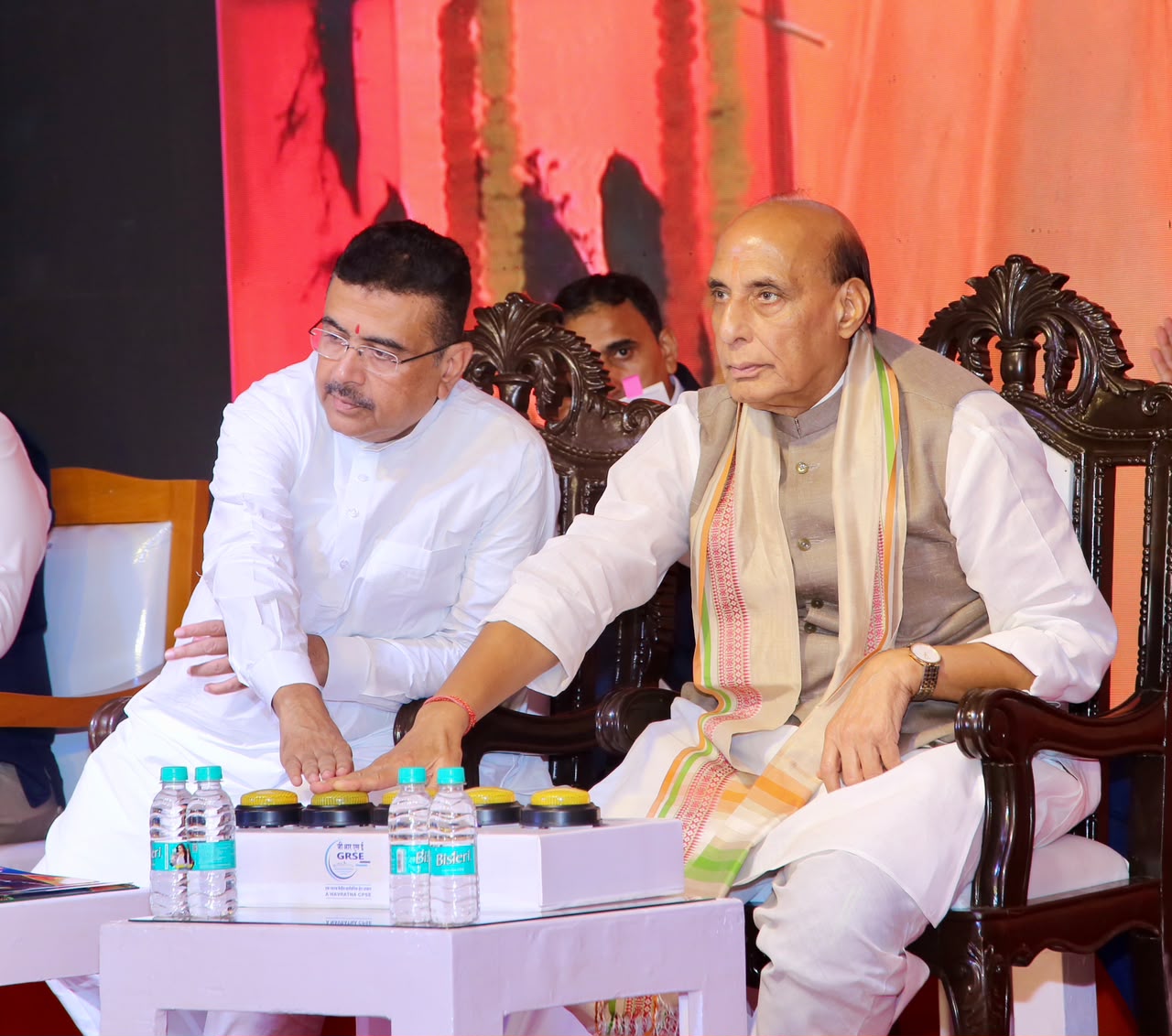
Defence minister Rajnath Singh, along with West Bengal chief minister Suvendu Adhikari, presided over the bhumi pujan ceremony for three expansion projects of Garden Reach Shipbuilders & Engineers Limited (GRSE) and two of Yantra India Limited (YIL), worth a total investment of approximately Rs 3,500 crore, virtually from GRSE Bhavan in Kolkata on 23 August 2026. The GRSE facilities at Kidderpore in Kolkata, Shalimar in Howrah, and Raichak in South 24-Parganas will bolster the country’s shipbuilding and ship repair capabilities, while the projects at YIL’s Metal and Steel Factory in Ishapore will strengthen indigenous metallurgical and production capabilities.
In his address, Singh said, “‘Raksha Shakti’ was among the ‘Saptadhara’, the seven streams of power, which PM Modi spoke about during his 2026 Independence Day address from Red Fort. He clearly stated that as we evolve into a developed nation, the defence sector must become fully self-reliant. We cannot remain dependent on any other country. It is our own companies and research institutes that must achieve complete dominance in this sector. These five projects reflect the government’s vision of ensuring strategic autonomy,” he said.
Singh added that these projects will not only boost defence production but also generate employment opportunities for thousands of people, as well as for MSMEs and allied industries. “In a sense, the projects are heralding a new chapter in West Bengal’s socio-economic progress,” he added.
The defence minister emphasised that Operation Sindoor demonstrated the critical importance of indigenous weapons & platforms, with the world witnessing the prowess of Indian defence systems. He stated that moving forward, the country’s labs, PSUs, and private stakeholders, in collaboration with the ministry of defence, will leave no stone unturned to equip the defence forces with indigenous platforms. “Self-reliance is not merely a policy; it is a force multiplier for battlefield capability. In this endeavour, the roles of GRSE and YIL will be crucial,” he added.
Commending GRSE for its efforts to achieve self-reliance in defence manufacturing, Singh made special mention of the advanced guided-missile frigate INS Dunagiri, which was dedicated to the nation by PM Modi earlier this year. “GRSE has constructed over 800 vessels to date. Even the next-generation offshore patrol vessels, currently under construction, will feature more than 80 per cent indigenous content. This demonstrates that we are rapidly reducing our dependence on foreign sources,” he added, while extending congratulations to the shipyard for achieving the ‘navratna’ status.
Singh described YIL as a strong pillar of India’s defence manufacturing capability, expressing hope that the new modern facilities at the Metal and Steel Factory in Ishapore will fully secure the critical supply chain for advanced weapons and strategic components. He highlighted that despite being established in October 2021, the company has overcome initial challenges and consistently achieved financial and regulatory excellence. “YIL has invested over Rs 750 crore in MSF Ishapore. By replacing legacy systems dating back to 1976, this investment will establish Industry 4.0-capable precision manufacturing, accelerating our progress towards indigenous manufacturing of weaponry,” he said.
Singh added that as the nation advances on the path of self-reliance with a positive mindset, there is a need to consider the emerging ‘Capacity Paradox’ in the global shipbuilding sector. He asserted that the demand for naval and commercial vessels is rising even as traditional shipbuilding nations witness a steady decline in capacity. He emphasised that this, coupled with the rapid pace of technological change, has created a global shipbuilding vacuum in design, manufacturing and maintenance, repair and overhaul (MRO), presenting a significant opportunity for India to emerge as a major global shipbuilding hub.
The defence minister emphasised that the design expertise, once held by traditional shipbuilding nations, is gradually diminishing, and India should leverage its pool of engineers, IT professionals and expertise in simulation & artificial intelligence to develop indigenous ship designs, secure patents and export them globally. On manufacturing, he stated that many developed countries are stepping back from labour-intensive shipbuilding due to soaring costs and a shortage of skilled manpower, while India possesses a skilled workforce, a robust steel industry and a strong MSME ecosystem. He stressed the need to modernise shipyards and adhere to global quality standards. “If we modernise our manufacturing capacity and adhere to global quality standards, India can emerge as the world's next major shipbuilding hub,” he said.
Terming MRO a ‘low-hanging fruit’ as it requires neither massive capital investment nor an enormous workforce, Singh called for India to establish itself as a hub for ship repair and overhaul in the Indian Ocean Region. “MRO simply requires quality, discipline, and reliable timelines. If we establish ourselves as a hub for ship repair and overhaul, we will not only save foreign exchange but also generate thousands of jobs,” he said.
He said that GRSE’s Raichak facility would provide the capability to build warships up to 200 metres in length and enable the shipyard to bid for next-generation destroyers, while the facilities at Timber Pond in Howrah and the Damodar Complex would strengthen the shipbuilding value chain. He added that the two forging facilities of YIL would produce high-quality metals for heavy artillery, naval weapons and advanced defence equipment, thereby strengthening the navy’s operational readiness.
Singh stressed that the expansion of shipbuilding and defence manufacturing would contribute to economic growth by saving foreign exchange, strengthening industries and MSMEs, and generating direct and indirect employment. He urged GRSE to make full use of its expanded capacity and compete more aggressively in domestic and international markets to realise the vision of ‘Make in India, Make for the World’. He called for globally trusted quality, competitive costs and timely delivery to secure repeat orders and establish India as a preferred supplier. “Our mindset should no longer be about what India needs to buy from the world. Instead, it should focus on what the world wants to buy from India,” he said.
He stated that the five projects represented a strategic expansion of India’s defence manufacturing capabilities and called for the combined participation of defence PSUs, private industry, MSMEs and academic institutions.
Speaking on the occasion, chief minister Suvendu Adhikari termed the bhumi pujan as a historic moment. He stated that the expansion projects will not only enhance the capacities of GRSE and YIL but also bring about a resurgence in West Bengal’s industrial sector. The projects will generate jobs and provide greater opportunities for ancillary industries, including MSMEs, he added.






 VIDEO
VIDEO