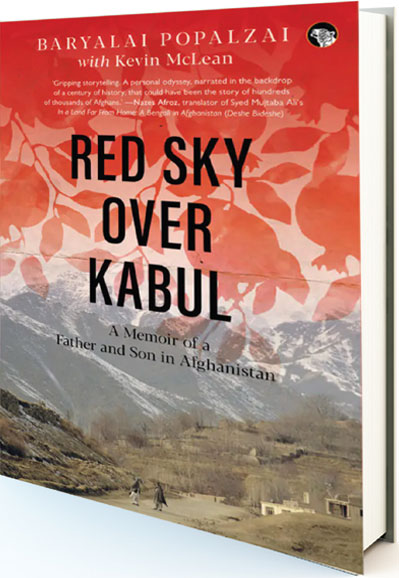
Baryalai Popalzai and Kevin McLean
At the beginning of January 2002, a few months after the US wrested control of my country from the Taliban, I received a call from Haroun Karzai, Hamid Karzai’s brother. Haroun was a friend and classmate of mine at Habibia High School, When the Russians invaded, he’d moved to the United States and opened an Afghan restaurant.
‘I’m going to Kabul, Bar,’ Haroun said. ‘Do you want to come with me?
His question caught me by surprise. I had abandoned the thought of returning to Afghanistan years ago. ‘I’m not sure,’ I answered. ‘The war may not be over.’
‘Things have settled down there now. It’s safe. I’m leaving next week if you want to come with me.’
At one time the chance to return to Kabul, to Karte Chaar, would have filled me with excitement. But now, to my own surprise, I was not sure I wanted to go. It would stir up too many painful memories.
‘Is anyone going with you? I asked, curious.
‘Baleh, there is someone who wants to work in the new government, an Afghan from Britain named Nabil who wants to be ambassador to London. The other is an American friend of mine who has an Afghan wife and wants to help rebuild the country.’
My father would have reminded me that every important decision should be made with the head, not the heart. Returning to Afghanistan would be a decision of the heart, and no doubt he would have considered it a foolish thing to do. Afsana felt the same. As a woman, it was too dangerous for her to accompany me, nor did she have any desire to do so because the country she had known no longer existed. But in the end, I only had ears for my heart.
Our flight to Kabul from Dubai was an Ariana Afghan Airlines plane, left over from the 1950s. The interior was filthy, the seats threadbare and the ashtrays overflowing with cigarette butts. Three flight attendants served us plates of chicken, rice with raisins and steamed spinach suffused with cumin and saffron. When I saw them approaching with more food, I thought what more could there be? They offered lamb kebabs smothered in onions and peppers, baskets full of oranges and pomegranates, and big cups of green tea. Even though I was already stuffed, I ate some of everything. We were cruising at 30,000 feet, but I felt as if I were already home.


 VIDEO
VIDEO