

Guts, Grit and Glory | Cadets first, Women Later
The mildly provocative question thrown at the panel of speakers at a recent ‘Ethos of Soldiering’ symposium at the Chandigarh Military Literature Festival was by a respected veteran brigadier. “Why are girl cadets at the NDA (National Defence Academy) sporting boy’s crew cuts? They needn’t do so. Why don’t we simply accept that gender differences will remain despite haircuts?” he asked. I volunteered to answer and quoted an anecdote.
On a lecture visit to my alma mater, the Officers’ Training Academy Chennai, I walked around the barracks lost in my yesteryears when a confident, crisp greeting startled me. The person in football shorts greeting me smartly was a feisty, infectiously cheerful lady cadet (LC).
“That’s OK sir” she chuckled. “My haircut must have fooled you. We are kept busy,” she rolled her eyes, “so we have no time managing our hair and chose really short boy-cuts.”
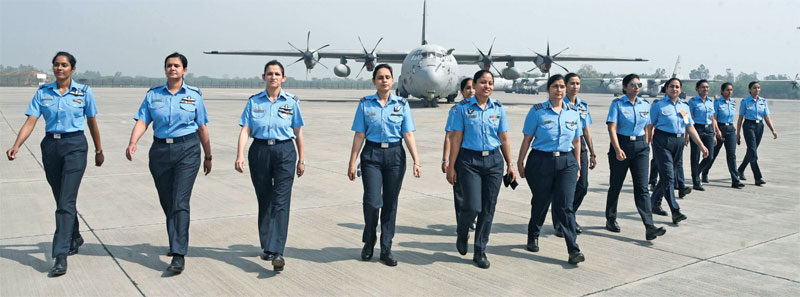
Indian Air Force women officers
The veteran questioner smilingly conveyed his satisfaction, but later a far more senior veteran confronted me, asking how was it that Sikh soldiers could manage their hair, but women cadets couldn’t.
Early in my career I had been posted as an instructor at the NDA. Queen Elizabeth visited the globally respected tri-service institution during my tenure on November 21, 1983 and she said the cadets at the passing out parade had set standards which the Royal Military Academy Sandhurst could learn from.
In May 2025, the spirited LCs of the 149th batch will set the same standards when they graduate from the NDA, matching their male colleagues step for step. The larger issue, however, goes well beyond haircuts, patriarchy, misogynistic mindsets and apex court intervention demanding a level playing field for uniformed women. There are unexplored or cursorily handled complex factors not just driven by gender differences and spiffy coping strategies by women, but deeper matters psychological and physiological that need candid, skilled and transparent handling and resolution on a practical timeline.
The NDA was born as the Joint Services Wing (JSW) in Dehradun on January 1, 1949, with the army component doing their advanced pre-commission training post JSW at the Indian Military Academy Dehradun with naval and air force cadets being directed respectively to Dartmouth and Cranwell Academies in the UK. The NDA shifted to its current location at Khadakvasla, Pune, in January 1955. It has produced 40,000 officers, including over 900 from friendly foreign countries. NDA graduates have earned three Param Vir Chakras, 12 Ashok Chakras and 32 Maha Vir Chakras besides distinguished service/other gallantry awards. It rates among the best tri-service academies worldwide. The 19 pioneering women cadets stand out for meeting impossibly high entry standards with their NDA odyssey commencing in June 2022 till June 2025, after which their advanced pre-commission training will commence at the IMA/NA/AFA.
The June 2022 reviewing officer, Navy Chief Admiral R Hari Kumar in his address hoped the NDA could harness the vast across-gender potential of youth by giving them equal opportunities to serve in gender-neutral defence services. Jawaharlal Nehru University vice-chancellor Dr Santisree Pandit, the chief guest at the convocation, sought gender sensitivity and integrated work ethic from the graduating cadets. A woman cadet, Shanan Dhaka from the Army Public School, Chandimandir, said “we are officer cadets first women later.”
The brilliant woman cadet Sania Mirza, the daughter of a Mirzapur TV mechanic, topped the UP boards before qualifying for the NDA and will become a fighter pilot. She idolizes pioneering top gun fighter pilot Flt Lt Avani Chaturvedi and seeks to be a cut above the rest in the Indian Air Force.
Masculine Mindsets
The reality is rather different from hopes and expectations. We cannot forget that the services prevaricated on the entry of women for decades. A detailed article by journalist Snehesh Alex Philip in February 2020 gives the reasons why India is not ready for women in combat roles. He tracked the entry of women since 1993 under the Special Entry Scheme, which later became the Short Service Commission (SSC) scheme. In addition to permanent commissioned women officers in the medical and legal branches, the government added signals, engineers, army aviation, army air defence, electronics and mechanical engineers, army service corps, army ordnance corps and intelligence in 2019.
Philip noted that the government in 2020 informed the Supreme Court that women “may not be able to meet the challenges... of military service due to their psychological limitations and domestic obligations, adding that male troops predominantly drawn from rural backgrounds may be unwilling to accept women commanders. Also, women officers (WOs) occupying command slots in peace stations (since they are not permitted in combat) will be counter-discriminatory since this implies that men would continue to remain on hard postings.” As for women in combat roles (infantry/armoured corps), Philip opined that “no matter how much you romanticise this, it’s practically impossible, especially in India.”
Subscribe To Force
Fuel Fearless Journalism with Your Yearly Subscription
SUBSCRIBE NOW
We don’t tell you how to do your job…
But we put the environment in which you do your job in perspective, so that when you step out you do so with the complete picture.


 VIDEO
VIDEO