

Book Extract | Equality in Violence
How sword has emerged as a tool of historic and caste pride. An extract.
 Brahma Prakash
In democracy, their (Kshatriya) honour can be violated any time. One takes out the sword when sentiments are hurt, when one feels wounded and victimized. The connection between the sword and the Kshatriya is well known. The sword has been one of the most significant cultural objects of honour and valour. It is perceived as an object of pride, an object of sacrifice. What we see in the return of the sword is the return of the idealized Kshatriya. The figure of the Rajput warriors and their fascination with war and kingdom. The Kshatriya’s image is also about clan feeling, not necessarily about caste feeling, though the two cannot be separated. It is about the clan feeling of the upper castes that brings them together. There is an attempt to foreground combative and fierce pasts and selective narratives. There is an attempt to ritualize the kingdom and warfare. A sword is an objective that creates an image of Kshatriyahood.
Actors who hold the sword carry the symbol—the sign and social pride of Kshatriyas. The connection is so strong that you take a sword and feel like a Kshatriya. You feel like a Rajput. One gets possessed by the power of swords. Who can capture this psyche of the sword better than novelist Phaniswarnath Renu? He writes in Maila Anchal:
The blood of Rajput youths boils after getting a shaft, spear and sword in their hands. That day, Hargauri was saying, ‘Sanyojak ji! I do not feel anger toward those Yavanas. I want to blow the neck of those Hindus who take the side of Yavanas.’ Sanyojak ji stood away; otherwise, Hargauri would have used the sword in a way that his neck would have been separated from his body… Aaryavarta… The name of Meriganj has perhaps changed to Aarjabrat [Aryavrata is my insertion].
A sword establishes a lineage. It carries bloodline; it marks a selection based on birth and power. Not everyone has the right to choose a sword. The selection has already been made by birth. It is an artefact of inheritance. It derives its copyright from the jati and varna systems. It is about the clan. The object is already encoded with names and whom it belongs to. There are coded histories on it. Written over are the war histories except the humiliating defeats of the Rajputs. A sword has to show that it was never defeated. It never surrendered. It is not surprising that, as Kshatriyas’ symbols of pride, swords and horses are not allowed to the lower castes even in weddings. It does not matter if one carried a more deadly weapon. A weapon was not about the lethality, it was about the legality—whether you have the sanction to carry it or not. By bringing in the Kshatriya values, Hindutva also aims to bring back the power of sanctions—the social sanctions that became illegal with the coming of the modern Indian Constitution.
But what should be the interest of Hindutva in bringing back the Kshatriya? Hindutva, in its core, still tries to maintain its inherent principles of varnaashramdharma (the system of social organization based on caste or varna). It has been trying to renew Brahminism. It has been trying to bring back the domination of Vaishyas in business. Likewise, it has been trying to bring back Kshatriya pride. The association of the sword with the power to kill is important here, as this legitimizes the violence of the Kshatriya. Also, it illegitimizes the resistance of the others. So killing by the Ranveer Sena and violence by the Karni Sena appear so natural, but when other social groups offer them resistance, it is deemed violent. While a sword is not seen as a violent weapon, but skullcap looks violent. They see a moustache as pride, but a beard becomes a threat. In recent history, Dalit and Mandal politics had shattered Kshatriya pride. Mandal politics of the 90s has made significant changes in representation politics and the Kshatriya was on the backfoot, mostly depending on the grace of OBC leaders in north India. Hindutva politics has given a new lease of life to its socio-political representation and the sense of pride. The sword is an important part of the reinforcement. It is not surprising that in the assertion of Hindutva politics, we are seeing a reassertion of medieval glory. Remember the image of the feudal lords wearing turbans, tika and moustaches, riding horses, carrying swords, abducting or protecting women.
Hindutva also wants to bring back swords because a sword carries pointed visions. If the bulldozer is about flatness, the sword is about pointedness. It makes a point, usually a statement: you surrender or get slashed. Once somebody has a sword in his hand, it is pointless to have any dialogue. You are with us or anti-nationals. You are our friend or an enemy. You are us or outsiders. The song of a sword ends up in valorization or denigration. The symbol stands against the spirit of dialogue. The sword is a statement of medieval superiority. People remember it: Jab baat baat par talwar nikal jati thee (When swords would be drawn in any argument). That is precisely what Hindutva wants to draw from the sword vision. The medieval period saw the shattering of Kshatriya pride. The so-called medieval period is full of the humiliating defeats of Rajput kings. Hindutva cannot accept these narratives. To counter it, it wants to bring back the glory of Kshatriyas. They want to create new narratives for a time full of hurt sentiments. Hindutva’s attempts to bring Kshatriya kings are about caste-varna and gender hierarchy. It is not pride but the sense of anxiety that has shaped the Hindutva history of swords.
Nonetheless, the sword rallies also see significant participation from the members of the subaltern communities. How do we see this participation? A case of subaltern Hindutva or Hinduized subalterns or something else? Some scholars want us to believe that Hindutva is getting subalternized. Hindutva has changed its savarna-centred politics and is opening up spaces. It is giving subaltern communities (i.e., the lower castes) basic access (constructing temple for their deities who otherwise remain in open). We can definitely say that the participation in a sword rally is one of the few places where Hindutva is creating a sense of participation. Historically excluded communities feel a sense of inclusion in such acts. Of course, hands that never held the sword are feeling a sense of pride. It is not surprising that bereft communities, after getting swords in their hands, feel a sense of power. It was the inaccessibility of sword and power that created this desire. A sword remains a special weapon in the memory of subalterns, both for its power and brutality.
A sword does something different for the subaltern communities, but it also keeps things the same. While the members of subaltern communities might feel a sense of equality with the sense of Hindu superiority, nothing much changes at the material level, such as equality of opportunities in education or the economy. This sword equality is grounded in the notion of violence. They can perpetuate violence like Kshatriyas, but not against the upper castes—only against Hindutva’s designated ‘other’. The swords give them a sense of pride: they come closer to Kshatriya values and try to become a mirror image of them. They feel a little like Kshatriyas.
There is no doubt that the communities, who were bereft of power and access, feel elevated after getting swords. Subalterns get a sense of power and enjoy the impunity of violence when it comes to Muslim others, but they will get badly punished if they rebel against the upper castes. ‘Feel proud that you have a sword now.’ The lure of feeling Kshatriya-like easily co-opted Shudras into the Hindutva fold without breaking any caste-varna hierarchies, and they too accept the supremacy of Brahminism. Instead of education, they get expression, instead of schools, they get swords. Instead of shouting Jai Bhim, they shout Jai Sri Ram.
Shudras are largely invested in agricultural work, though this is changing now with the increasing urbanization. But they remain in service, from haircutting to ploughing, and other productive work. For radical politics, Shudras should fashion their productive tools as weapons. They may find their historical feeling with a sickle and a spade. It does not mean that they necessarily become communists but they should definitely claim their historical experience to claim new politics, as Dalits and Ambedkarites did in one way or the other. Unless they realize it, they will remain fodder for the Hindutva cannons. Even if we accept that the Shudras were Kshatriyas in history, it does not serve any purpose in the present. The Shudras’ history has to be carved in the history of experiences and not in the fake pride that they add with moustache and sword. Take modern weapons if you need, use a pen or gun, or both, or take a call when it is a matter of dignity of labour and the question of justice.
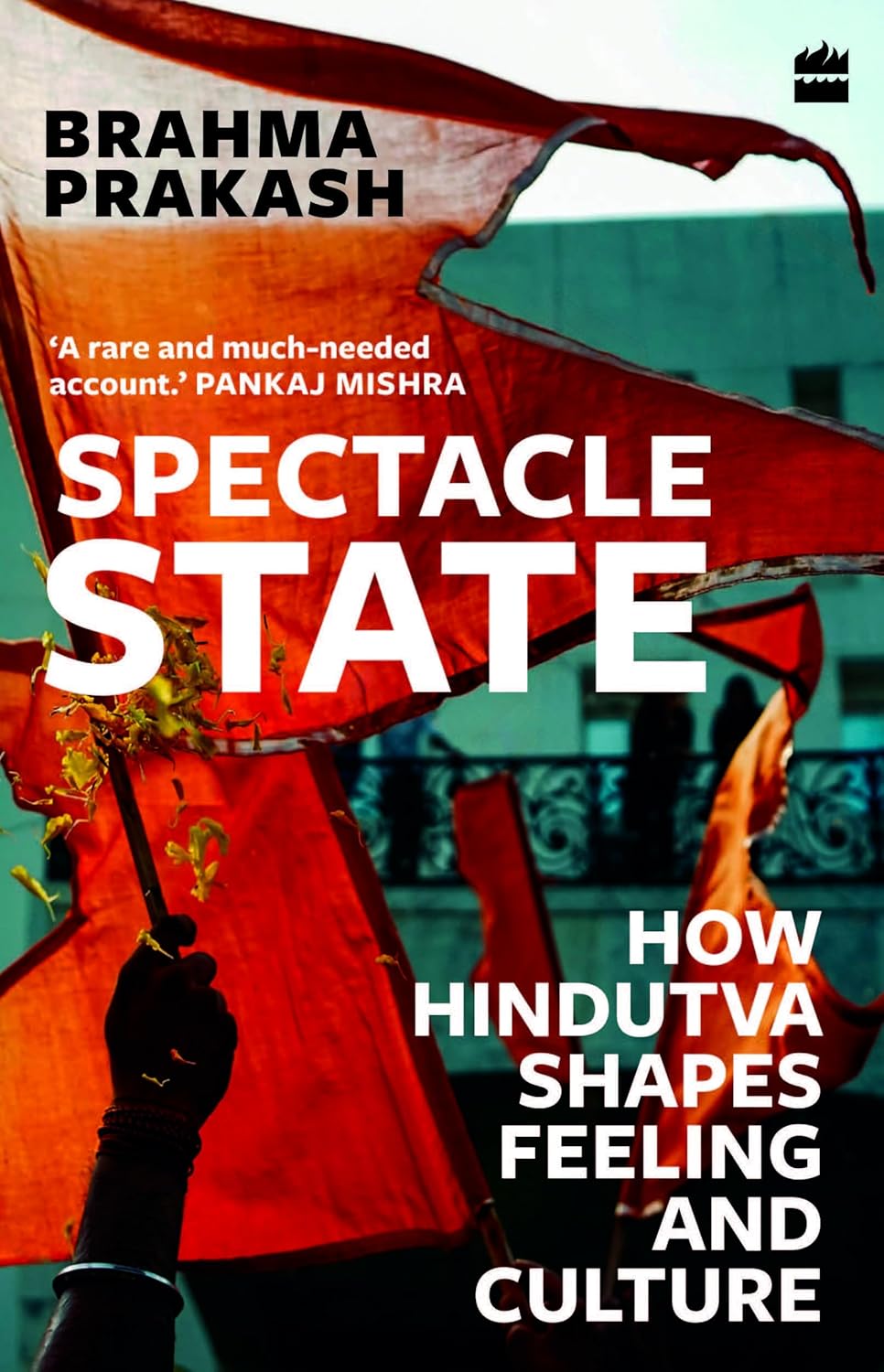
SPECTACLE STATE: HOW HINDUTVA SHAPES FEELING AND CULTURE
BRAHMA PRAKASH
HarperCollins, Pg 263, Rs 599
 VIDEO
VIDEO